Tencent researchers develop AI platform for dual-target peptide design
Researchers from Tencent’s AI for Life Sciences Lab led development of ORIDTP, an AI platform for designing peptides that act on two targets. The study was published on 25 November 2026.
Key takeaways · 4
- 01
ORIDTP was developed by researchers from Tencent’s AI for Life Sciences Lab.
- 02
The platform designed co-agonist peptides for the GLP-1 and glucagon receptors.
- 03
The lead metabolic candidate showed effects in obese and diabetic mouse models, not in patients.
- 04
Tencent made ORIDTP open source, and the study’s source code is available on GitHub.
A platform for two-target design
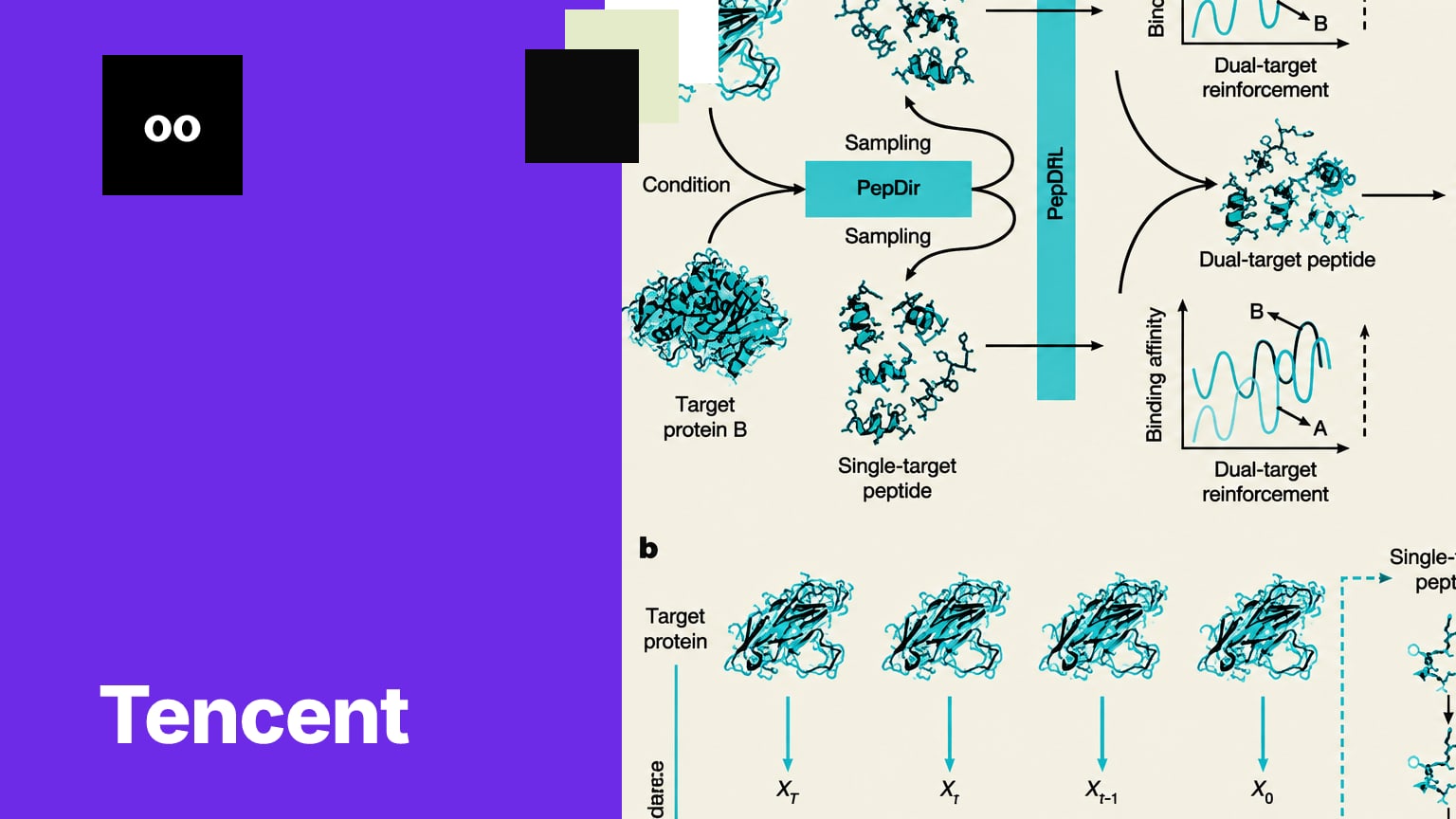
Researchers from Tencent’s AI for Life Sciences Lab led development of ORIDTP.[1] The platform combines single-target knowledge transfer with dual-target reinforcement to design high-potency peptides.[2] The researchers say designing peptides that work at both targets has been difficult because of low design success rates and weak bioactivity.[2] Peptides are short chains of amino acids that can act on specific receptors to regulate physiological functions.[3]
Metabolic receptor results
ORIDTP designed dual-target co-agonist peptides for the GLP-1 receptor and the glucagon receptor, also known as GCGR or GLR.[2] The researchers generated 5,000 candidate peptides, selected 15 promising candidates and repeatedly tested their activity.[3] Six designed peptides had greater bioactivity than the strongest natural binders of each receptor.[2] The lead peptide, GA-Dual.R5.S3, produced substantial weight loss and improved glycaemic measures in diet-induced obese mice.[2]
Findings in mouse models
GA-Dual.R5.S3 also had pronounced antidiabetic effects in db/db mice without inducing nausea or aversion.[2] A mouse comparison tested GA-Dual.R5.S3 alongside semaglutide and mazdutide, with treatments administered every other day for 21 days.[3] The researchers cautioned that the results do not show the obesity candidate is clinically superior to semaglutide.[3] The study is preclinical, and further testing is needed to establish whether the effects will occur in patients.[3]
Checkpoint peptides and availability
A zero-shot design produced dual-target co-inhibitors for PD-1 and CTLA-4.[2] Of 15 designed checkpoint-targeting peptides, eight blocked both checkpoint interactions.[2] Three showed in-vivo antitumour efficacy in mice bearing tumours with human checkpoint proteins.[2] The lead checkpoint peptide, IC-Dual.P3, reduced tumour volume by 94.2% relative to controls.[2] Tencent made ORIDTP open source for researchers developing drugs for a range of diseases, and the study’s source code is available on GitHub.[3][2]
For drug-discovery teams, ORIDTP offers a design approach to explore peptides aimed at two targets and a platform they can examine or adapt. The mouse findings justify further investigation, but they do not establish patient benefit or clinical superiority.
Why it matters
AI training for your team
kju.ai is built for teams: daily sessions, team analytics, and rollout support for your organization.
How this developed
28 November 2026
Tencent researchers develop AI platform for dual-target peptide design