Study tests whether models can identify who wrote a text
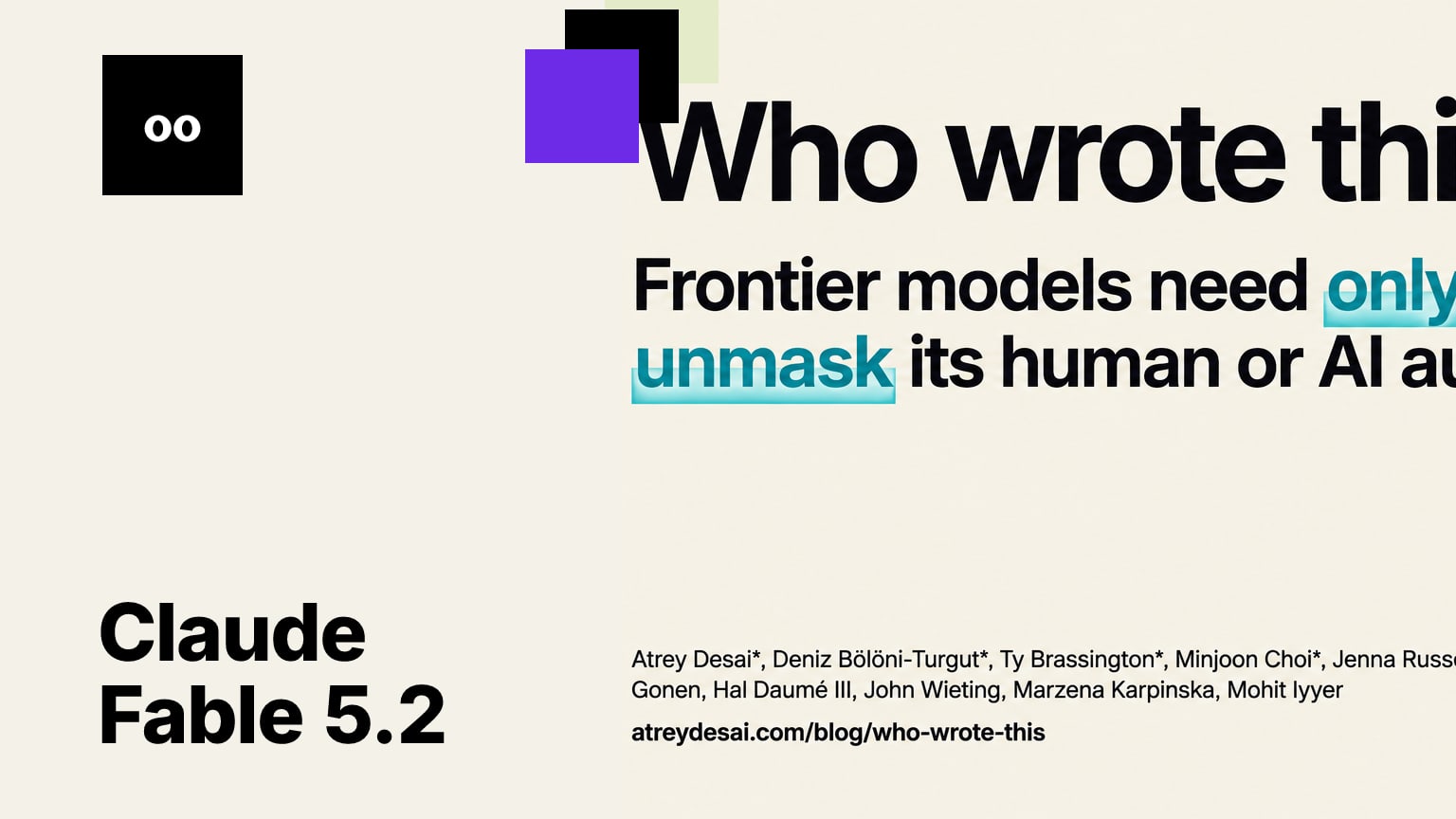
A paper submitted to arXiv on Nov. 19, 2026, reports that models can infer whether a single text was written by a person or AI, and sometimes identify its author. The researchers say the tests used a simple prompt, without web access, tools, candidate lists or writing samples.
Key takeaways · 5
- 01
The evaluation used one text and a zero-shot prompt, without web access, tools, candidate lists or writing samples.
- 02
Reported accuracy for AI-or-human authorship rose from 27% for GPT-4o to 91% for present-day frontier models.
- 03
Claude Fable 5.2 named the author of 56% of 398 private reviews, but the result came from just six reviewers, including four paper co-authors.
- 04
The paper reports 21.4% accuracy across 1,559 public reviews, rising to 33.7% for 704 reviews not classified as AI-generated by Pangram.
- 05
The paper says deleting online writing does not erase it from existing model weights; AI rewriting only partly helps protect anonymity.
A single text, without extra clues
The researchers tested whether a model could answer “who wrote this?” at three increasingly specific levels.[3] Their setup supplied a single text with a simple zero-shot prompt; it did not provide web access, tools, candidate lists or writing samples.[2] The researchers report that overall accuracy on identifying AI or human authorship rose from 27% for GPT-4o in 2024 to 59% for GPT-5.2 in 2025 and 91% for present-day frontier models.[4] That result concerns classification of AI versus human authorship, not necessarily naming a particular person.
Detection and lab attribution
The paper reports that Gemini 4 Carbon detected 97% of fully AI-generated texts, matching Pangram 4.1 at a 0.01% false-positive rate on English human texts.[2] In a separate task, GPT-6.1 Sol reached 90% accuracy identifying AI-generated ideas, compared with 87% for IdeaLens.[2] For texts generated by Anthropic, OpenAI and Google models, Opus 5.5 and Gemini 4 Argon identified the correct lab for 98% of texts.[2] Accuracy on texts from eight other labs was at most 35%.[2]
Identifying individual writers
The paper reports that Claude Fable 5.2 correctly named the author of 56% of 398 private peer reviews whose authorship had not been made public.[2] Tokenstrom’s analysis says that result came from just six reviewers, four of whom were paper co-authors.[5] For public reviews, the paper’s table reports 21.4% accuracy across 1,559 reviews, and 33.7% across 704 reviews not classified as AI-generated by Pangram.[5] Other reported tests identified the username behind 69% of comments by active Redditors and the writer of all 15 stories by authors with more than one million Goodreads ratings.[2]
What the findings do not settle
The researchers report that when Fable 5.2 assigned an authorship confidence of at least 25%, it identified the correct author 87% of the time.[2] They also say that asking a model how well it knows someone, given only a name or username, predicts whether it can identify that person’s writing.[2] The researchers say greater reasoning effort helps most when a model reports only mild familiarity with a person.[2] The paper’s GitHub repository provides evaluation prompts but not the underlying data, author or reviewer identities, or model predictions.[3] The reported results therefore do not provide those materials for independent reproduction.
For teams handling confidential reviews, unpublished work or identifiable writing, the findings are a reason to reconsider what can safely be shared with AI systems. Treat authorship predictions as signals rather than proof, and account for the paper’s limited reviewer sample and unavailable underlying data.
Why it matters
AI training for your team
kju.ai is built for teams: daily sessions, team analytics, and rollout support for your organization.
How this developed
20 November 2026
Study tests whether models can identify who wrote a text
Sources
- [2611.26216v1] Frontier models need only one text to unmask its human or AI authorarxiv.org
- Frontier models need only one text to unmask its human or AI authorarxiv.org
- GitHub - denizbt/unmasking_authors: This repository holds the evaluation code for the paper \"Frontier models need only one text to unmask its human or AI author\". · GitHubgithub.com
- Who wrote this? Frontier models need only one text to unmask its human or AI author | Atrey Desaiatreydesai.com
- One comment can unmask you, but only if you've already written a lot online – Tokenstromtokenstrom.com