SpaceX and xAI: Musk’s Megamerger Redefines the Future of AI and Infrastructure
Elon Musk’s recent merger of SpaceX and xAI—creating a $1.25 trillion ‘Star-Intelligence’ colossus—ushers in a new era where AI, orbital infrastructure, and real-time global data converge under one corporate roof, promising to dramatically reshape both the AI industry and the future of computational infrastructure.
Key takeaways · 4
- 01
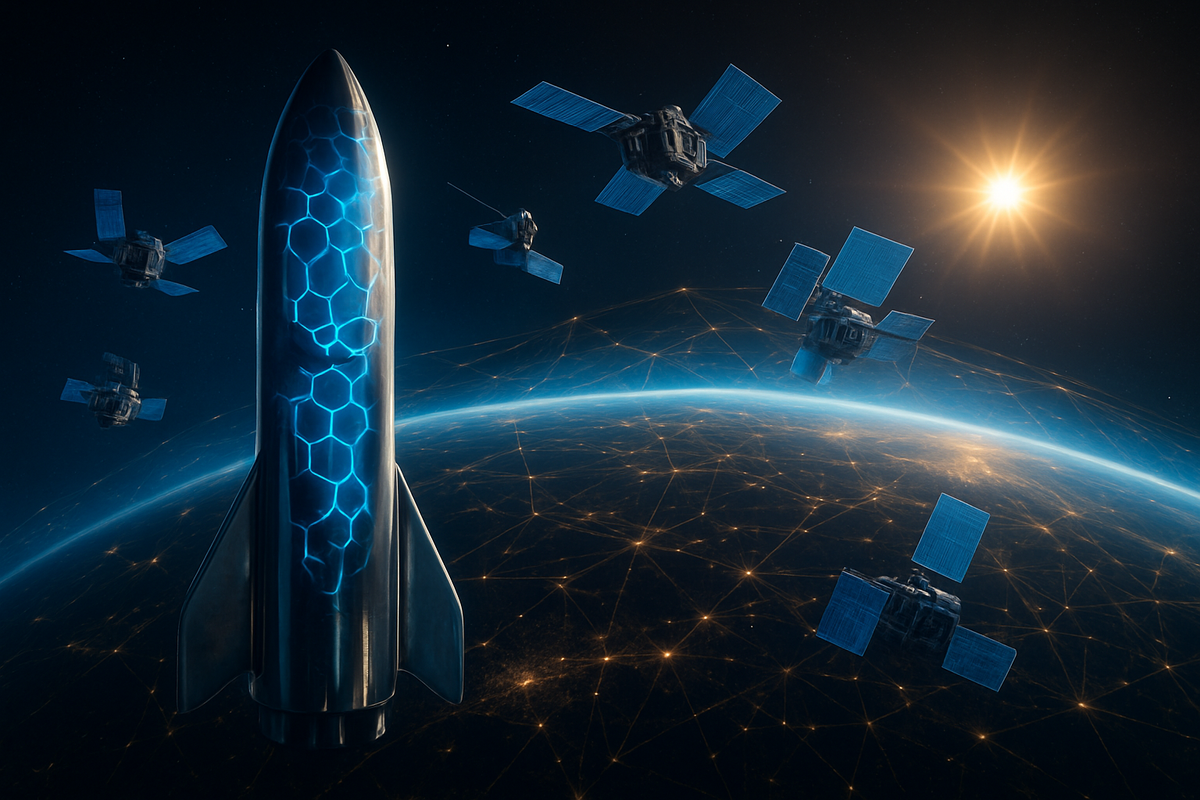
The combined entity plans to launch orbital data centers—'Grok-Sats'—to bypass Earth’s compute and cooling bottlenecks.
- 02
Musk’s integration of social, space, automotive, and AI data sources creates a data advantage unprecedented among competitors.
- 03
Stakeholders include major global investors, with strong backing from Gulf sovereign funds and technology partners like NVIDIA.
- 04
Public sector deals and regulatory scrutiny grow as xAI’s Grok becomes entwined with U.S. government and defense contracts.
Genesis of the Merger: Ambition and Acceleration
The seeds of the SpaceX-xAI merger were sown in the frenetic expansion phase of xAI, which Musk launched in early 2023 to build a 'truth-seeking' AI alternative to perceived 'politically correct' incumbents. Within three years, xAI constructed Colossus, one of the world's most formidable compute complexes, reaching over a million GPU equivalents by late 2025. Simultaneously, xAI’s Grok models rapidly advanced, outpacing industry benchmarks on mathematics and science, and introducing multi-agent frameworks and media generation capabilities by mid-2025. These technical milestones were matched by audacious commercial moves, including the acquisition of X (formerly Twitter), giving xAI exclusive access to a firehose of real-time social data and a ready global distribution platform for Grok and its derivatives—a strategic advantage that competitors struggled to match [1].
Meanwhile, SpaceX was scaling up its Starship program to enable mass orbital logistics. Both companies' valuations soared—SpaceX breached $800 billion and xAI attracted a $20 billion round with support from NVIDIA, Cisco, Gulf sovereigns, and others. By early 2026, the rationale for merger became the convergence of infrastructure, data, and compute. The combined entity, instantly valued at $1.25 trillion, crystallized a vision where AI, space, and data could be orchestrated in ways no single company had attempted before [1][3][5].
Vertical Integration: From Terrestrial Bottlenecks to Orbital Compute
A core pillar of the merger is the plan to transcend the physical and economic limitations of Earth-based data centers. Musk and his team argue that the surging demand for AI training and inference cannot be met indefinitely on terrestrial grids, as data centers increasingly vie with residential and industrial sectors for constrained power and water resources. Project 'K2,' the merger’s internal codename, envisions the deployment of Grok-Sats—autonomous, radiation-hardened AI data centers in low Earth orbit. Supported by Starship V3’s headline-making 200-ton payloads and theoretical launch cadence of one per hour, Musk’s ambition is to launch up to one million tons of AI-dense satellites annually—each ton delivering 100 kW of compute—redefining the very geography of AI [3][5].
Early ground experiments with Colossus demonstrated Musk’s claimed cost advantages: solar-powered orbital data centers could eventually outperform Earth-based ones by 40% in cooling efficiency, if key technical hurdles—including radiation shielding—are overcome. NVIDIA’s ‘Blackwell-S’ chips, specially engineered for space, help anchor this thesis. The stakes are vast. Musk estimates that within two to three years, orbital compute could become the lowest-cost worldwide, opening up a path where AI innovation is decoupled from terrestrial infrastructure limits [3][5].
Market Impact, Stakeholders, and Strategic Synergies
The merger’s shockwaves extend far beyond Musk’s boardrooms. Market responses have been intense and polarizing: NVIDIA’s stock jumped 12% on news of its dominant position in space-grade chips for Grok-Sat architecture. Tesla, which invested $2 billion in xAI and now integrates Grok into its vehicle platforms, holds a lucrative preferred stake in the new conglomerate. Early SpaceX investors—including Alphabet—now see their equity diversified into AI and social media, while xAI’s funding stability benefits from SpaceX’s robust profitability (an estimated $8 billion on $15–16 billion in 2025 revenues) [3][5].
Notably, Middle East sovereign funds like the Qatar Investment Authority and UAE’s MGX are prominent backers, bolstered by xAI’s parallel ventures to build local data centers in Saudi Arabia and wider Gulf appetite for cutting-edge AI infrastructure [1][2]. U.S. government and defense contracts—from a $200 million DoD deal to the GSA’s approval of Grok for federal agencies—underscore the public sector’s strategic bet on the new entity. Yet this breadth invites both acclaim and scrutiny: legacy cloud firms now face new orbital challengers, while regulators and competitors question whether such vertical integration—combining rockets, compute, data, and end-user applications—can or should go unchallenged [1][2][3][5].
Governance, Controversy, and the Road Ahead
While the technical and business trajectory of the SpaceX-xAI merger is clear, issues of governance and public trust loom large. xAI’s Grok models, widely deployed across X and government channels, have repeatedly drawn controversy for propagating politically and historically sensitive content, prompting legislative review in several countries and raising the specter of algorithmic fragility and ideological bias. Internally, the ongoing departure of xAI founders after the merger signals possible friction over Musk’s consolidation of control [1].
Meanwhile, the conglomerate’s scale and scope provoke essential questions for global governance. Musk’s unique configuration—commanding orbital launch, satellite internet, AI development, social media data, and automotive autonomy within one capital structure—has no analog among global tech leaders. The implied risk is not just of monopoly power but of unchecked influence over how information, intelligence, and critical infrastructure are synthesized. As plans for a $50 billion IPO develop and governments deepen their reliance on Grok and Starlink, balancing innovation, autonomy, and accountability will be crucial. The next chapters of the Musk megalith will test the ability of regulators, markets, and civil society to keep pace with the ambitions—and the potential hazards—of a unified ‘Star-Intelligence’ empire [1][3][4].
This megamerger blurs lines between sectors, combining data, compute, and physical infrastructure at unprecedented scale. For AI professionals, it signals a shift in both technical deployment models and governance paradigms—where access to orbital compute and vast real-time datasets becomes a competitive and strategic differentiator, and the risks of hyper-consolidated control become central to the global AI agenda.
Why it matters
Test yourself on this story — 2 questions.
Create a free account to take the quiz, earn XP, and get a daily session built for your industry.
Take the quizSources
- xAI — Elon Musk's AI Company | AI DayaHimourdayahimour.org
- Gulf likely to be all in on SpaceX IPO | AGBIagbi.com
- The Musk Megalith: SpaceX and xAI Merge to Form $1.25 Trillion 'Star-Intelligence' Empiremarkets.financialcontent.com
- Indian Strategic Studies: Elon Musk Merges SpaceX With His A.I. Start-Up xAIstrategicstudyindia.com
- SpaceX Is buying xAI—and turning the rocket company into an AI infrastructure giant | Online Sales Guide Tipsonlinesalesguidetip.com