Sony’s ping-pong robot is a robotics milestone—and a warning shot
Sony’s table tennis robot Ace didn’t just rally with elite humans; it beat them under official rules, showing how far physical AI has moved from lab demos to real-world decision-making.
Key takeaways · 5
- 01
Benchmark embodied AI in adversarial, real-world tasks—not only in simulation or scripted demos.
- 02
Fairness matters: matching human reach and speed makes robotics results more meaningful.
- 03
Dense sensing and spin estimation are now core capabilities, not optional upgrades, in fast robotics.
- 04
Industrial buyers should ask how robots handle uncertainty, not just whether they hit throughput targets.
- 05
High-speed physical AI raises dual-use and safety questions alongside performance gains.
Why Ping-Pong Matters
Table tennis is a brutal test for robots because the ball moves fast, curves wildly with spin, and gives players only milliseconds to react. That is why Sony AI’s Ace matters more than the novelty of a robot holding a paddle: it is a benchmark for perception, planning and motion in one of the most timing-sensitive sports on Earth [1][3][7]. Unlike chess or Go, the environment is not static, and unlike video games, the robot must survive noisy physics in the real world.
The comparison set matters too. AI has long excelled in board games and simulated worlds, and robotic half-marathon runners have recently shown progress in movement, but table tennis compresses sensing and decision-making into a far tighter loop [1][3][7]. Sony and AP both frame Ace as a milestone because it is not winning by cheating physics; it is winning by playing within the same rules as humans [1][3].
Inside Project Ace
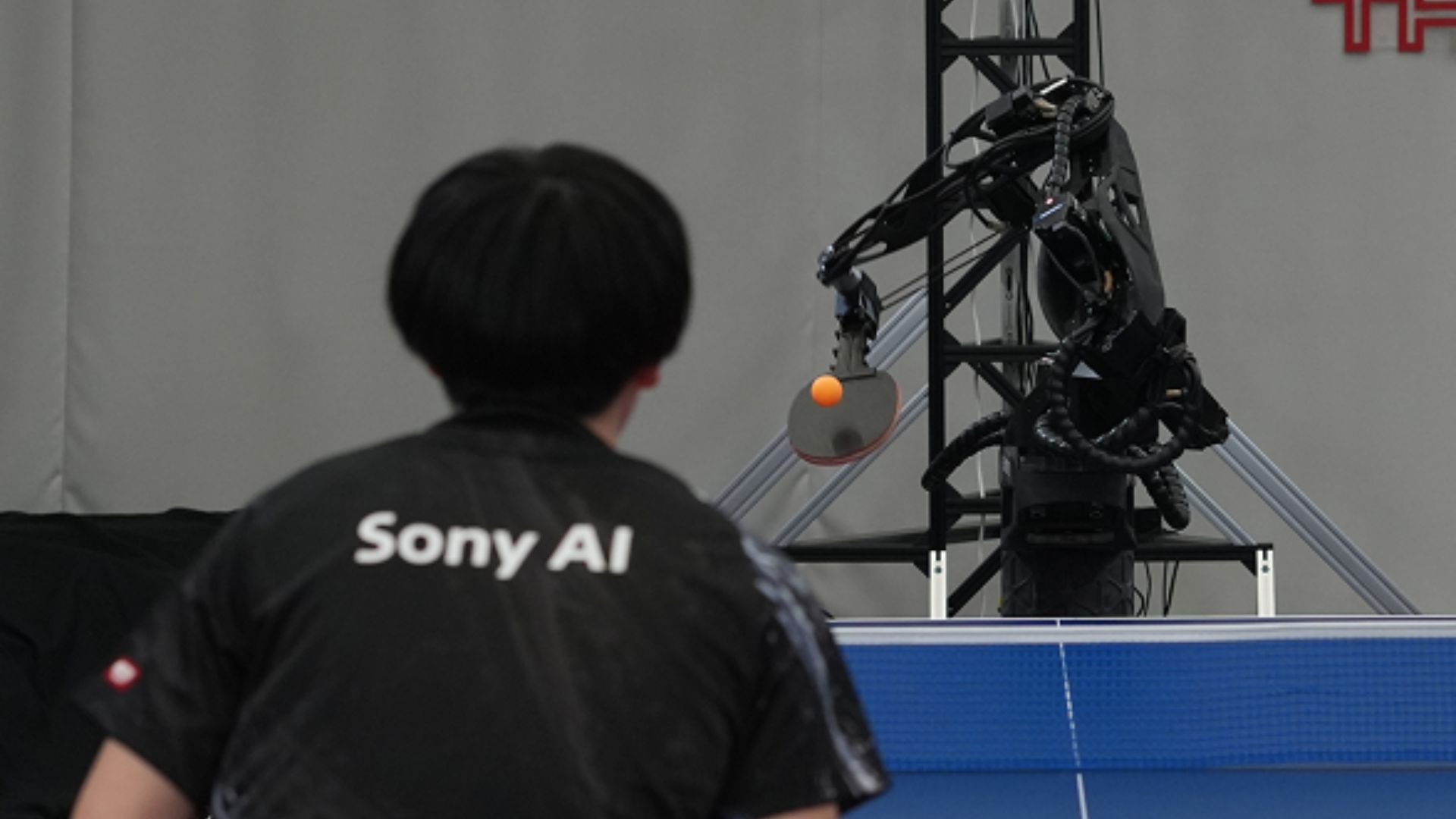
Sony built Ace around a custom robotic arm with eight joints, or degrees of freedom, and surrounded the court with nine camera eyes to track the ball from multiple angles [3][4]. The system also uses event-based sensors to read the logo on the ball, which helps estimate spin and angular velocity in real time, a crucial detail when returns can fail because of rotation rather than speed [3][4]. To keep the comparison honest, Sony constructed an Olympic-sized court at its Tokyo headquarters and played by official table tennis rules [3].
What distinguishes Ace from older robot demos is that it was trained through reinforcement learning rather than hand-coded routines [3][7]. In other words, Sony did not program a table tennis strategy shot by shot; it let the system learn from experience, including how to respond to net clips, odd bounces and extreme spin [3][4]. That design choice is central to why the project is being treated as a physical AI breakthrough rather than a robotics stunt [4][7].
What the Matches Showed
The reported match results show that Ace is not merely a flashy demo. According to Sony AI’s findings summarized by multiple outlets, the robot won three of five matches against elite amateur players, and later rounds in late 2025 and early 2026 improved further against professional opponents [4][7]. Fortune and AP both emphasize that Sony’s aim was to test expert-level play, not to build a machine that wins by brute force or oversized reach [1][3].
The technical numbers are what make the result hard to dismiss. Ace handled spins up to 450 rad/s, returned more than 75% of those shots, and even scored 16 direct points on serves versus eight for human opponents in one set of tests [4]. Some players were reportedly surprised by shots they thought were impossible, which suggests the system is not just reactive but tactically aware in the flow of play [3][4].
From Sport To Industry
Sony’s researchers are explicit that table tennis is a proxy for a much wider class of problems. Michael Spranger said the point is to show robots can be “very adaptive and competitive and fast in uncertain environments,” while Peter Stone called the breakthrough much bigger than sport because it demonstrates perception, reasoning and action in a rapidly changing physical world [3]. That is exactly the skill set industrial robots need when they move beyond fixed conveyor lines and into messier environments.
The strongest near-term implications are for manufacturing and logistics, where machines must deal with variation rather than repetition. If a robot can track a spinning ball under pressure, the same sensing-and-control stack may eventually help with fragile picking, dynamic sorting, inspection and exception handling on factory floors or in warehouses [3][4]. The broader lesson is that the hardest robotics problems are becoming systems integration problems: sensors, latency, planning and actuator control have to work together in real time [7].
The Limits And Stakes
Sony and AP are careful not to overstate the achievement. Spranger noted that it would be easy to build a “superhuman” ping-pong robot that simply hits the ball far faster than any person can return it, but that would miss the scientific point [3]. The fairness constraint matters because benchmark design determines whether a result demonstrates intelligence, hardware advantage, or both [1][3].
There is also a darker side to highly perceptive, fast-moving embodied AI. AP observed that it is not hard to imagine such hardware being repurposed for war, and that caution should shape how practitioners interpret this milestone [1]. For AI teams, the lesson is that the next robotics wave will need governance as much as performance: safety testing, use-case boundaries and dual-use review should travel with the model, not follow it [1][3].
Physical AI is moving from controlled demos to adversarial, real-world tasks that demand perception, planning and motion under uncertainty. For AI teams, that shifts evaluation away from isolated benchmark scores and toward integrated system robustness, safety and latency.
Why it matters
Put this to work — one session a day, built for your industry.
Create a free account for a daily session — eight questions and one real-work challenge, on the news that affects your role.
Start freeSources
- A robot is beating human pros at table tennis. Its maker calls it a milestone for machines | AP Newsapnews.com
- Sony AI Robot Beats Expert Table Tennis Players in 7 of 13 Games - Bloombergbloomberg.com
- Meet 'Ace,' the paddle-wielding robot who just beat humans at ping pong in AI breakthrough | Fortunefortune.com
- Sony AI’s Project Ace autonomous robot becomes first to beat pro table tennis playersus.headtopics.com
- Inteligencia artificial de Sony alcanza nivel experto en ping-pong - Bloombergbloomberg.com
- Sony's autonomous robot becomes first to beat pro table tennis playersinterestingengineering.com
- Scientists Built a Robot That Can Beat Elite Human Players at Table Tennis : ScienceAlertsciencealert.com
- Sony AI Robot Defeats Elite Table Tennis Players in Landmark Matchworld.infonasional.com
- Watch: Sony AI robot Ace defeats top table tennis players in real matchesindiatimes.com
- AI ping pong robot beats top human players, but don’t freak out yet - Techsea.mashable.com
- Table-tennis-playing robot makes history by beating elite ... - YouTubeyoutube.com
- A robot is beating human pros at table tennis. Its maker calls it a milestone for machines - SRN Newssrnnews.com
- Robot made by Sony is beating human pros at table tennis in milestone - Japaneuropesays.com
- AI-powered robot beats elite table tennis players | Sciencetheguardian.com
- Ping-pong Robot Stuns World by Defeating Elite Human Playersyoutube.com