Researchers test direct editing of neural-network weights
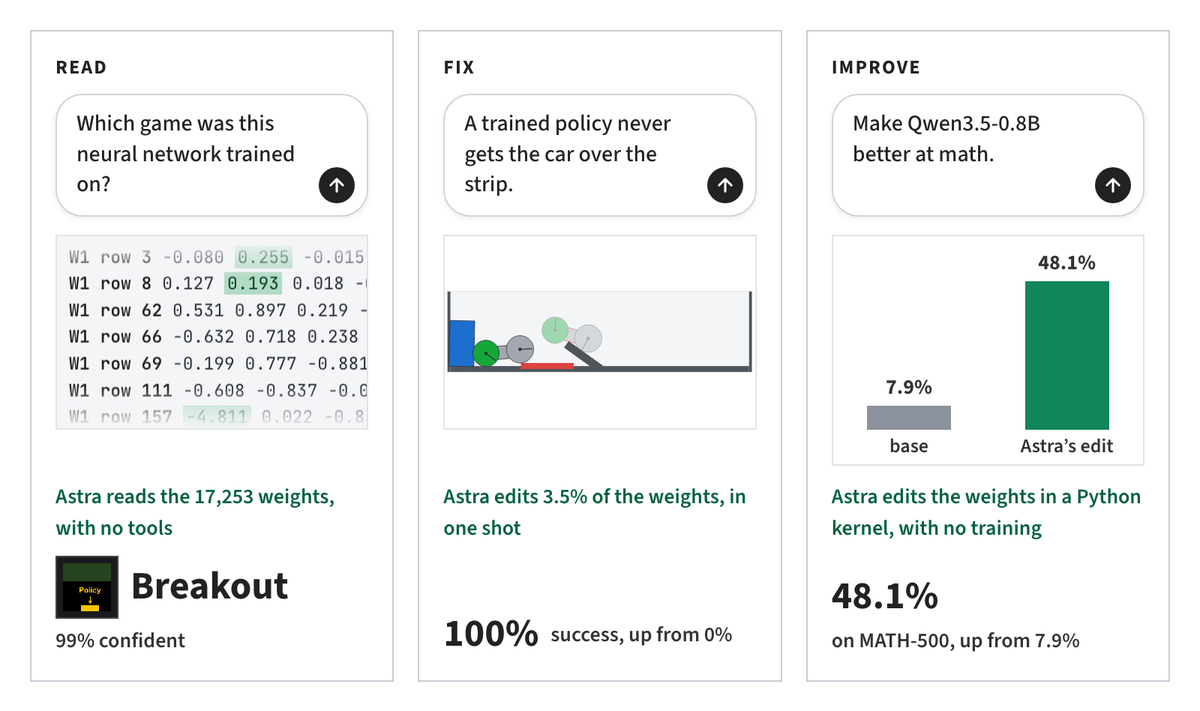
Researchers tested whether an LLM could interpret and change neural-network weights directly, without gradient descent. Their experiments included identifying small networks, creating and improving models, and editing a small language model for math performance.
Key takeaways · 4
- 01
The approach, called Weight-Space Programming, has an LLM read and write network weights directly rather than relying on gradient descent.
- 02
Astra identified four small game networks from their raw weights, without being told which games to consider.
- 03
The researchers reported that a Qwen weight correction raised MATH-500 from 7.9% to 48.1%, while changing 0.016% of weights natively.
- 04
The strongest Qwen attempt involved 158 conversational turns, 80 Python runs and 20.3 hours, according to VentureBeat.
A different way to work with weights
Weight-Space Programming asks an LLM to inspect or alter a network’s weights directly, rather than using gradient descent to update them.[1] The researchers reported eight experiments covering weight interpretation, network creation and model improvement, using OpenAI’s GPT-6 Astra.[2] The work therefore tested more than one task, but the results cited here span small game networks, diffusion models and a language-model math edit.[1][2]
Reading small networks
For a game-identification test, Astra received raw network weights as text and was not told which games were under consideration.[1] It named the right game for all four networks.[1] The networks used the same MLP structure—500 → 32 → 32 → 5—with 17,253 weights, and the games were grid versions of Breakout, Pong, Pac-Man and Freeway on a 10×10 grid with five actions.[1] Separately, Astra identified the shapes generated by small diffusion models by examining their weights, without running the models or performing forward passes.[2]
Editing a model for math
The researchers asked Astra to improve Qwen3.5-0.8B at math without gradients.[1] The reported weight correction raised MATH-500 from 7.9% to 48.1%, with a native change to 0.016% of the weights.[1] Analytics India Magazine reported increases from 13.8% to 67.1% on GSM8K and from 21% to 62.3% on IFEval.[2] VentureBeat reported that the strongest attempt took 158 conversational turns, 80 Python runs and 20.3 hours, including time waiting through an outage.[3]
Results come with limits
The researchers attributed Qwen’s improvement to correcting repetitive reasoning loops.[3] The blog author described the issue as loops after 32,000 tokens that caused longer math tasks to fail, and said Astra wrote four pairs of texts, measured weights contributing to looping and began cutting them down.[4] The blog author called direct editing an impressive trick, but not a radical new capability, and argued conventional training remains the best way to update weights.[4] VentureBeat noted that the research did not establish consistent advantages over conventional training in speed, cost or effectiveness.[3]
Direct weight editing is a possible additional tool for teams exploring model behavior or targeted changes. The reported gains are notable, but professionals should weigh them against the time and effort described and the absence of evidence that this approach consistently outperforms conventional training.
Why it matters
Bring this to your team — one session a day, built for your industry.
kju.ai is built for teams: daily sessions, team analytics, and rollout support for your organization.
For teamsHow this developed
3 November 2026
Researchers test direct editing of neural-network weights
Sources
- Sparks of Weight-Space Programming: LLMs can natively read & write neural network weightsrikiyat.github.io
- MIT Researchers Show LLMs Can Read and Edit Neural Networkanalyticsindiamag.com
- 'Like gene editing for neural networks': MIT researchers used GPT-6 Astra to edit Qwen's open weights directly, boosting math performance | VentureBeatventurebeat.com
- LLMs are not superhuman at reading and writing neural network weightsseangoedecke.com