Perplexity launches Multiagent for complex Computer tasks
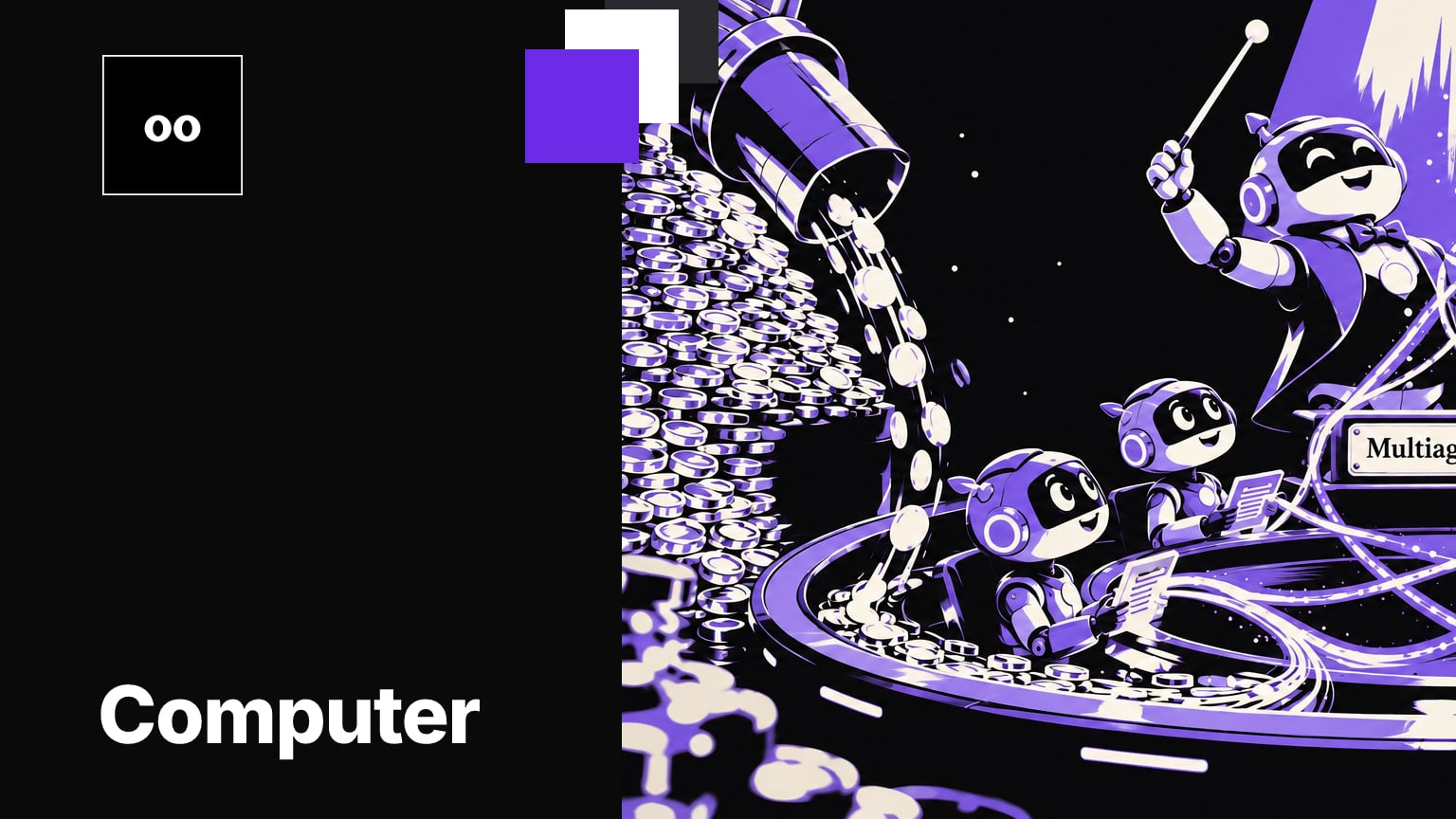
Perplexity introduced Multiagent, a new effort level for Computer’s most complex work. The feature coordinates agents running different frontier models to work in parallel and cross-check findings.
Key takeaways · 4
- 01
Multiagent is designed for tasks with distinct parts that benefit from parallel analysis and cross-checking.
- 02
The default supporting team is Claude Opus 5.5, GPT 6.1 Sol and Gemini 4 Carbon, coordinated by Claude Fable 5.2.
- 03
Users can see which agents and models are running and guide the work through the lead agent.
- 04
Perplexity calls Multiagent credit-intensive, but its launch thread did not publish a price or credit figure.
A lead agent coordinates the work
Perplexity introduced Multiagent as a new effort level above Ultra for Computer’s most complex work.[1] The lead agent can assign work to as many as 16 agents while handling part of the task itself.[1] Perplexity says the agents run different frontier models, work in parallel, share findings directly and check one another’s work.[1] The lead then combines their findings into a single response with the requested deliverables.[1] Perplexity describes the feature as suited to work with distinct parts that benefits from parallel analysis and cross-checking.[1]
The model lineup and handoffs
Perplexity says Claude Fable 5.2 plans the task and divides it among agents running Claude Opus 5.5, GPT 6.1 Sol and Gemini 4 Carbon.[1] Those three models are the default supporting team.[1] Claude Fable 5.2 and GPT 6 Astra can also join as supporting agents when requested or when a task component calls for them.[1] That setup differs from Ultra agents, which Perplexity says report only to the lead.[1] For a valuation task, Perplexity gives the example of one agent updating revenue assumptions and notifying another agent to use them in its analysis.[1]
Visibility, control and availability
Users can see which agents and models are running during a task, according to Perplexity.[1] They can guide the work through the lead agent without messaging each supporting agent separately.[1] Perplexity says that when changes affect agents, the lead tells them on a follow-up and the team continues its existing work.[1] Multiagent is available to all Perplexity Max subscribers on the web; ORIENS also reports web availability for Enterprise Max subscribers.[1][2] Perplexity describes the feature as credit-intensive and recommends reserving it for important tasks, while CellCog reports that no price or credit figure appeared in the launch thread.[3]
Tests show gains, with reporting limits
CellCog reports that Perplexity tested five frontier models alone, as two and four copies, and leading mixed teams of four.[3] In Terminal-Bench 4.1 results, every mixed team beat four copies of its lead model by 0.008 to 0.125, according to CellCog.[3] The Gemini 4 Carbon-led team scored 0.727 in a run costing $10.31; CellCog reports that the top mixed team cost $10.31 per run, compared with about $13 for four copies of its lead model.[3] CellCog also reports mixed-team gains on WANDR, but says the launch thread gives no run counts per score or spread between runs.[3] The published results therefore do not show how much scores varied across repeated runs.
Teams considering multi-model workflows can assess whether parallel analysis and cross-checking fit their tasks, while keeping an eye on usage costs. The absence of a published credit figure and run-to-run reporting makes it harder to estimate expense and judge how stable the reported benchmark gains are.
Why it matters
AI training for your team
kju.ai is built for teams: daily sessions, team analytics, and rollout support for your organization.
How this developed
18 November 2026
Perplexity launches Multiagent for complex Computer tasks
Sources
- Introducing Computer’s Multiagent effort levelperplexity.ai
- Perplexity adds \"Multiagent\" effort level to \"Computer\" and \"teammates,\" splitting work among agents on different frontier models; launches on the web for Max and Enterprise Max | ORIENSai-oriens.com
- Perplexity Multiagent: Mixed-Model Teams, Benchmarked | CellCogcellcog.ai