OpenAI introduces BioBasicsBench for routine wet-lab analysis
OpenAI introduced BioBasicsBench, a benchmark for measuring how AI agents handle routine wet-lab analysis. Developed with biotech company Ligo, it tests agents on 100 tasks using raw experimental data.
Key takeaways · 4
- 01
The benchmark has 100 tasks based on raw experimental evidence, including gel images, colony plates, microscopy and instrument readouts.
- 02
Tasks span protein methods, imaging and cytometry, quantification and assays, nucleic acid methods, and molecular cloning.
- 03
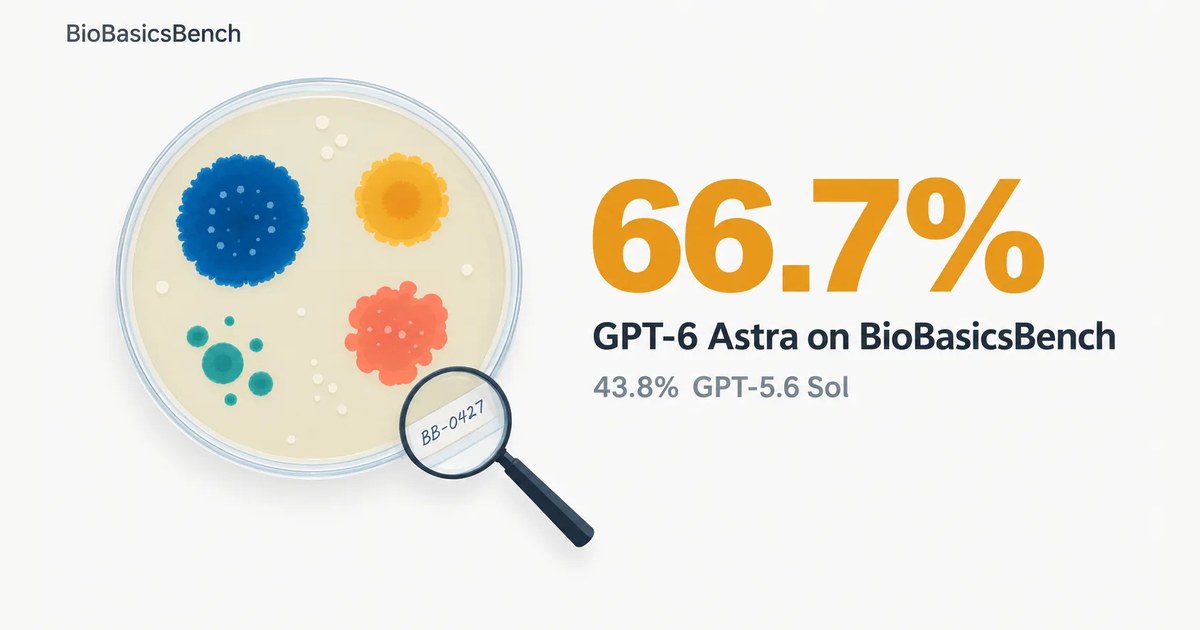
At xhigh, GPT-6 Astra earned 66.7% of available credit, versus 43.8% for GPT-5.6 Sol.
- 04
OpenAI identifies image interpretation, control checking and experimental context as areas where agents still need improvement.
What the benchmark measures
Its 100 tasks test whether agents can interpret raw experimental data, spot errors and recognize when the evidence cannot support a conclusion.[1] The benchmark spans protein methods, imaging and cytometry, quantification and assays, nucleic acid methods, and molecular cloning.[1] Its inputs include gel images, colony plates, microscopy and instrument readouts.[1] This gives teams evaluating agents a concrete set of lab-analysis capabilities to consider.
How tasks are built and graded
Scientists created the tasks using data from their own experiments, and each task is paired with expert-written grading criteria.[1] Each task received an internal review from a Ligo scientist who did not write it, an external review from a wet-lab scientist with a PhD, and a final internal review.[1] Agents return structured answers that may include a requested conclusion, measurement or recommendation, with supporting reasoning when required.[1] The benchmark awards credit against individual rubric criteria, so it can distinguish a correct conclusion from a partially correct analysis.[1] For teams, that scoring detail is useful when assessing more than a single final answer.
Reported model scores
At the xhigh reasoning setting, GPT-6 Astra earned an average of 66.7% of available credit; GPT-5.6 Sol earned 43.8%.[1] OpenAI characterizes the results as evidence of progress in routine lab analysis, while identifying image interpretation, control checking and the use of experimental context as areas needing improvement.[1] CellCog separately reports that GPT-6 Astra used 4,704 output tokens per task, compared with 9,099 for GPT-5.6 Sol.[3] Teams comparing these figures should keep the sources and measures distinct.
The limits of benchmark performance
OpenAI says routine wet-lab work can involve failed experiments, ambiguous images and conflicting observations.[1] It also says benchmarks based on charts and images selected for scientific papers may miss ambiguity and the troubleshooting that it requires.[1] CellCog cautions that higher benchmark scores do not yet mean models can make reliable judgments in the lab.[3] Its reported examples include GPT-6 Astra catching a control plate labeled for the wrong antibiotic, but also picking the wrong colonies from a cloning gel and overcounting a colony plate by about 12%.[3] These results counsel against treating an overall score as proof of dependable performance on every task.
For teams assessing AI in research workflows, BioBasicsBench offers a way to examine specific analysis skills and errors rather than relying only on a headline score. It also makes clear that stronger benchmark performance is not, by itself, evidence of reliable lab judgment.
Why it matters
Bring this to your team — one session a day, built for your industry.
kju.ai is built for teams: daily sessions, team analytics, and rollout support for your organization.
For teamsHow this developed
7 November 2026
OpenAI introduces BioBasicsBench for routine wet-lab analysis
Sources
- Measuring how AI agents handle everyday wet-lab science | OpenAIopenai.com
- OpenAI on X: \"A new way to measure how AI agents handle the routine analyses of wet-lab science—BioBasicsBench. Developed with Ligo, a biotech company focused on enzyme design, the benchmark draws on 100 tasks from real experiments to test whether agents can interpret raw lab data, identify errors… / Xx.com
- OpenAI BioBasicsBench: GPT-6 Astra Scores 66.7% on Lab Work | CellCogcellcog.ai