OpenAI Details GPT-Live Architecture for Continuous Stateful Voice
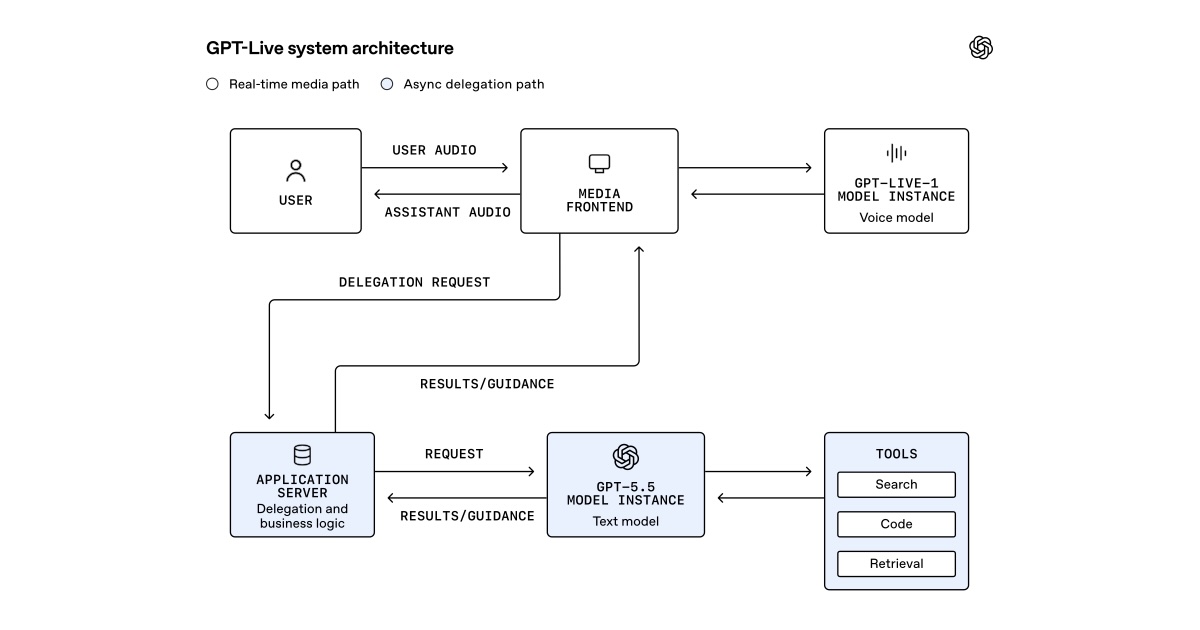
OpenAI has published the architectural details behind GPT-Live, a real-time voice system designed to isolate latency-sensitive media processing from broader application logic.
Key takeaways · 3
- 01
GPT-Live separates media and inference paths from application logic to maintain conversational responsiveness.
- 02
Session contexts can migrate between model instances to handle capacity changes and context limits.
- 03
OpenAI used WebRTC extensions like WARP and silent testing on live voice traffic to optimize performance.
Isolating the Live Path
OpenAI designed GPT-Live by isolating media processing and model inference from tools, delegation, and persistence. [2] The live path exclusively runs the media pipeline and inference loop, while application logic operates behind an asynchronous remote procedure call (RPC) boundary. [1] This separation addresses the need for conversations to remain responsive even when external services or other operations introduce variable latency. [1]
By keeping application logic outside the latency-sensitive path, a tool call can wait on a database or API without blocking audio delivery. [2] Justin Uberti, Head of Realtime AI at OpenAI, stated that achieving target latency required consistent media delivery, leading to the architectural choice to restrict the live path. [1]
Stateful Sessions and Pre-Launch Testing
GPT-Live utilizes dedicated, stateful inference for each session on an assigned instance. [1] While sessions reserve capacity on their assigned instance, OpenAI can move an existing session's context to another instance when draining capacity or when a conversation reaches its context limit. [1][2]
For its media foundation, OpenAI retained WebRTC and introduced WebRTC Abridged Roundtrip Protocol (WARP) improvements and Instant Connect to reduce startup latency. [1] Before launching the system, OpenAI conducted a "silent" test that mirrored production voice traffic while discarding the output. [1][2] This testing method exposed load-related behavior and failures that synthetic tests had failed to identify. [1][2]
What it means
OpenAI's architectural breakdown of GPT-Live illustrates the technical requirements for delivering fluid, real-time voice AI at scale. By strictly decoupling the media and inference loops from application logic like database lookups or tool use, OpenAI addresses the core latency bottleneck that has historically plagued voice agents. The use of stateful session management with movable context further demonstrates a sophisticated approach to dynamic resource allocation. What the sources don't address: How much overhead the context migration process adds to overall system latency during peak traffic periods.
The GPT-Live architecture provides a blueprint for building low-latency, real-time AI applications by decoupling synchronous media processing from asynchronous application tasks. This approach is critical for developers aiming to build responsive agents that must simultaneously handle audio streaming and external tool usage.
Why it matters
Turn this story into practical AI skill after launch.
Get the release link for daily sessions built around your role and industry.
Join the waitlistHow this developed
2 September 2026
OpenAI Details GPT-Live Architecture for Continuous Stateful Voice
2 September 2026
Event created from source cluster.