GPT-5.5 is OpenAI’s clearest bet yet on autonomous work
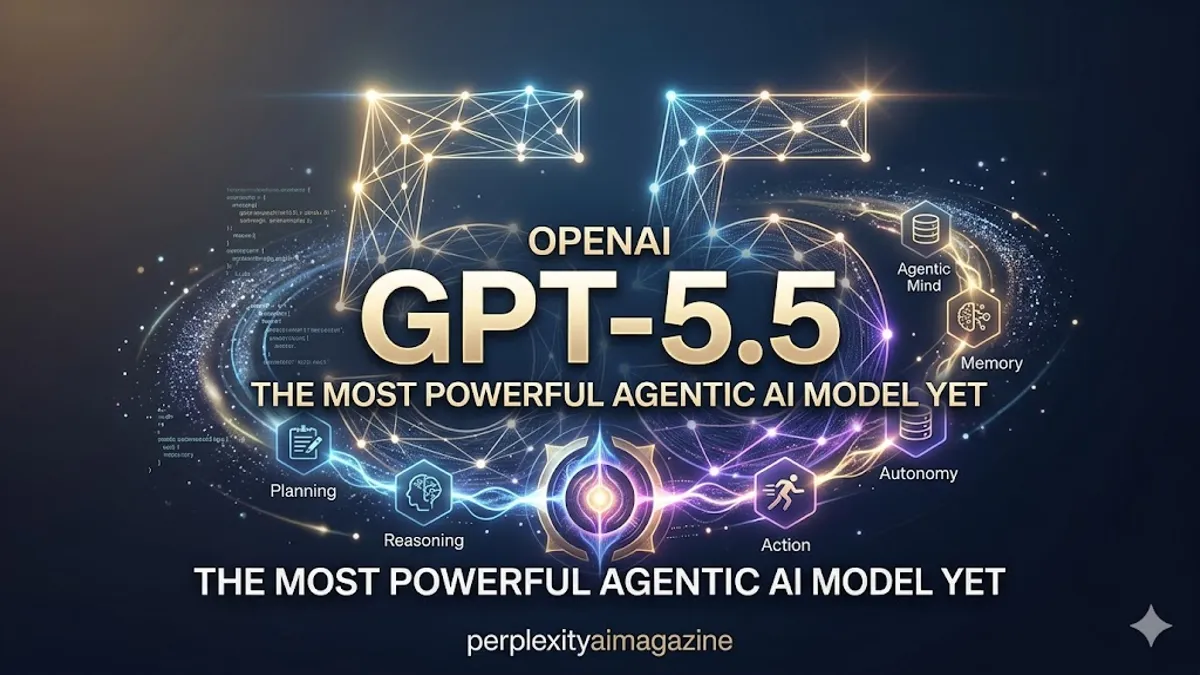
OpenAI’s GPT-5.5 is less a routine model bump than a reset: a fully retrained system built to plan, act, and finish multi-step work across code, documents, and tools.
Key takeaways · 4
- 01
Treat GPT-5.5 as a new model family, not a drop-in upgrade; prompt and workflow revalidation will matter.
- 02
The biggest gains are in agentic coding, long-horizon tasks, and tool use—not raw chat quality alone.
- 03
Higher token prices mean ROI depends on whether improved output quality cuts human review time.
- 04
Teams handling sensitive work should assume stronger capabilities also mean tighter safety and governance needs.
A fast, strategic launch
OpenAI’s GPT-5.5 arrived on April 23-24, only about six weeks after GPT-5.4, which makes the release more than a simple version bump [1][2][4]. Multiple reports describe the model, codenamed "Spud," as the first fully retrained base model since GPT-4.5, rather than another post-training iteration layered on the same foundation [2]. That distinction matters because OpenAI is signaling a reset in architecture, training data, and agent-oriented objectives, not just another incremental polish.
The timing also looks competitive by design. Anthropic had just pushed out Claude Opus 4.7 and related previews, and OpenAI appears intent on reclaiming narrative momentum in coding and enterprise use cases [1][2][4]. The company can point to scale that few rivals can match: more than 900 million weekly ChatGPT users, over 50 million subscribers, 4 million active Codex users, and 9 million paying business customers [1][2]. With annualized revenue already in the tens of billions, GPT-5.5 is both a product launch and a statement that OpenAI still plans to set the pace [2].
What actually improved
OpenAI says GPT-5.5 is strongest where work unfolds over time: agentic coding, computer use, knowledge work, and early scientific research [1][7][8]. The model can write and debug code, research online, analyze data, build documents and spreadsheets, and move across tools until the job is done, often with less guidance than previous versions [1][10]. OpenAI also folded Codex into GPT-5.5, retiring the separate coding model and betting that a unified system is better than routing users between specialized products [5][7].
The benchmark picture suggests broad, not narrow, gains. Reported scores include 82.7% on Terminal-Bench 2.0, 58.6% on SWE-Bench Pro, 84.9% on GDPval, 78.7% on OSWorld-Verified, and 98.0% on Tau2-bench Telecom [2][8]. OpenAI also says the model helped discover a new proof related to off-diagonal Ramsey numbers, later verified in Lean, which is a useful signal that the system is beginning to contribute to structured research rather than only summarize it [8].
Prompting and access reset
One of the clearest practical signals in this release is OpenAI’s guidance to start "minimal and from scratch" rather than porting prompts from GPT-5.4 [5]. The company also said role definitions, once dismissed by some practitioners, are back in the front of effective prompt design [5]. That means the model’s instruction-following behavior has changed enough that old templates may underperform, especially in workflows where prompt shape, tone, and role framing were previously tuned to the old base model.
Access is also more tiered than a simple launch note might imply. GPT-5.5 is rolling into ChatGPT Plus, Pro, Business, Enterprise, and Edu, with a GPT-5.5 Thinking variant for heavier tasks and GPT-5.5 Pro reserved for higher tiers [3][8]. Free users remain on GPT-5.4, while Go users get limited access to GPT-5.5 Thinking; developers see a one-million-token context window but also a steep pricing jump to $5 per million input tokens and $30 per million output tokens [3][5][8]. In practice, this means the upgrade is as much an operational decision as a capability upgrade.
Safety and infrastructure
OpenAI paired the launch with unusually explicit safety language. The company says GPT-5.5 underwent third-party safeguard testing, internal and external red-teaming, and targeted evaluation for cybersecurity and biological risk, with nearly 200 trusted early-access partners feeding back before release [1][8]. OpenAI classifies the model as High risk for biological, chemical, and cybersecurity domains, but says it did not cross its Critical cybersecurity threshold [8]. That matters because the same agentic qualities that make the model useful also make it more consequential if misused.
The infrastructure side helps explain how OpenAI kept latency flat while raising capability. The company says GPT-5.5 was co-designed, trained, and served on NVIDIA GB200 and GB300 NVL72 systems, with inference rewritten to improve load balancing and partitioning [8]. One report says Codex helped analyze production traffic patterns and write heuristics that lifted token generation speeds by more than 20% [8]. In other words, part of GPT-5.5’s advantage comes from systems engineering, not just model scale [7][10].
Why enterprises care
The business case is straightforward: GPT-5.5 is trying to move AI from chatbot to autonomous coworker [6][10]. OpenAI says more than 85% of its own staff use Codex weekly, and it cites examples such as reviewing 24,771 K-1 tax forms, summarizing six months of speaking requests, and automating weekly business reporting that saved employees five to ten hours [8]. ContentBuffer notes that workspace agents built on the model can save sales teams five to six hours per week, which is the kind of concrete productivity claim enterprise buyers actually evaluate [6].
The broader implication is that organizations will need to measure AI as a workflow system, not a novelty layer. GPT-5.5’s gains in long-horizon coding, research, and document generation make it attractive for teams that can replace multiple tool hops with one agentic process, but the doubled token price forces discipline on usage [5][8]. The winners will be teams that re-benchmark tasks, redesign prompts, and decide where human review is still worth the cost.
GPT-5.5 reinforces a shift from conversational AI toward systems that can execute work across tools, not just answer questions. For practitioners, the immediate lesson is that prompt design, evaluation, and cost controls now matter as much as raw model quality. The model’s stronger autonomy raises the value of governance: the more it can do, the more important it becomes to define permissions, verification steps, and escalation paths before deployment.
Why it matters
Put this to work — one session a day, built for your industry.
Create a free account for a daily session — eight questions and one real-work challenge, on the news that affects your role.
Start freeSources
- OpenAI GPT-5.5 release — Its Most Powerful Agentic AI Model Yetperplexityaimagazine.com
- GPT-5.5 Explained: Everything You Need to Know About OpenAI's Most Powerful Modelmiraflow.ai
- GPT-5.5 OpenAI: official benchmarks and feedbackanthemcreation.com
- OpenAI Nears Launch of GPT-5.5 Codename 'Spud' - Ontime+ontimebrief.com
- OpenAI GPT-5.5 Is Here: Better Coding, Agentic AI, and a Higher Price Tag - techwithbrad.comtechwithbrad.com
- OpenAI Releases GPT-5.5 With Autonomous Tool Use and Self-Correction — ContentBuffer Newscontentbuffer.com
- GPT-5.5 Is Here: OpenAI's Smartest Model Targets Enterprise and Science - techwithbrad.comtechwithbrad.com
- OpenAI rolls out GPT-5.5 with coding & research gainsitbrief.news
- OpenAI Launches GPT-5.5 with Advanced Coding and Agentic…thetoolpicker.com
- OpenAI: GPT-5.5 Introduced As Most Advanced Model Yet For Real-World Work And Agentic AIpulse2.com
- OpenAI Debuts GPT-5.5 Claiming Agentic Coding and Research Gainsground.news
- GPT-5.5 API: Automation That Actually Finishes - Blue Lightningbluelightningtv.com
- What are the features of GPT-5.5, OpenAI's smartest model yet?inshorts.com
- OpenAI GPT-5.5 Release: A Powerful Step Toward the AI Superappbitcoinworld.co.in
- DeepSeek V4: Open-Source AI at 1/6 Cost of GPT-5.5 | byteiotabyteiota.com
- DeepSeek V4 Pro and Flash Models Narrow the Gap with Frontier AIm.dailyhunt.in
- OpenAI Launches GPT-5.5 as Rivalry with Anthropic Sharpens Over ...linkedin.com
- OpenAI Releases GPT-5.5, Aiming for 'Superapp' Future Amid ...techstrong.ai
- AI - OpenAI has released GPT-5.5, its most advanced model yet ...facebook.com