OpenAI's Evolved Agents SDK: Production-Grade Sandboxes and Memory for Enterprise AI
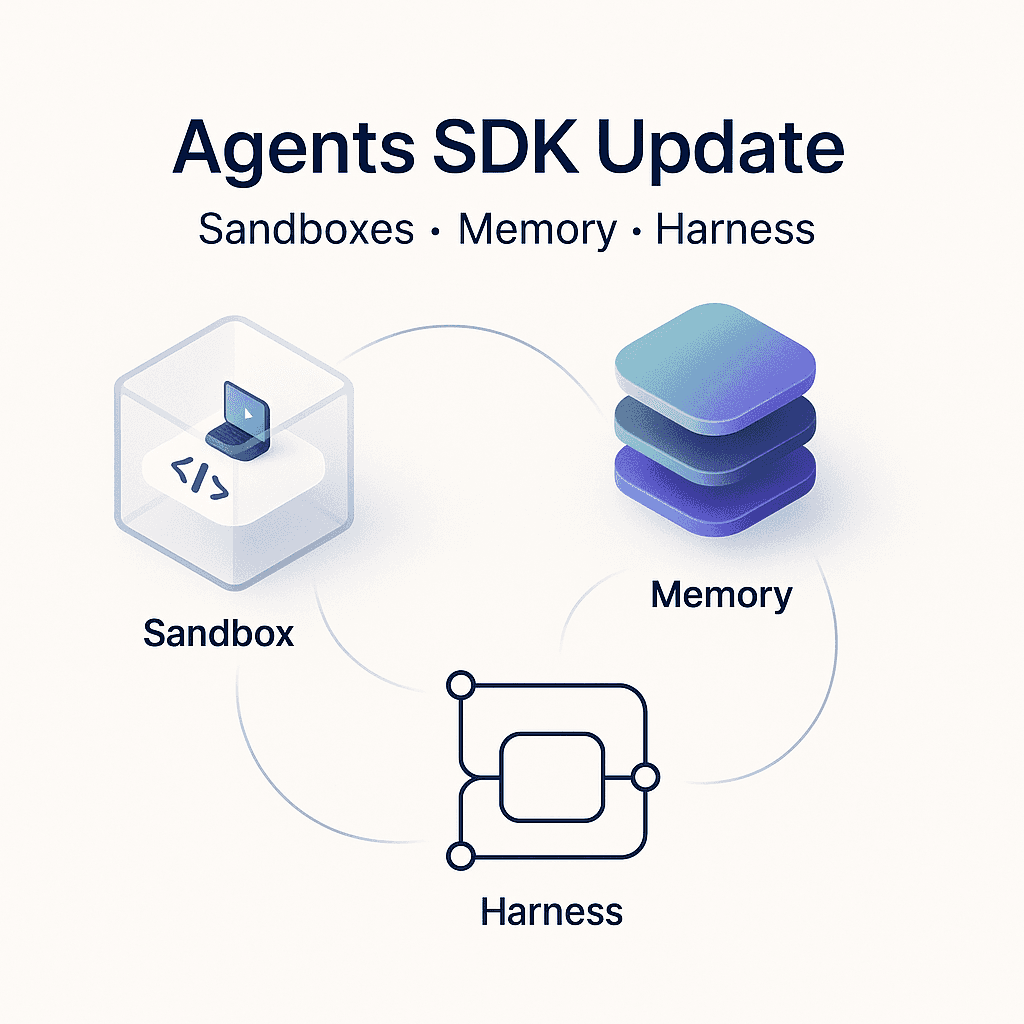
OpenAI’s April 2026 Agents SDK update delivers a major leap in enterprise-ready agent infrastructure, debuting robust native sandboxes, configurable memory, and an enhanced harness to safely orchestrate complex, multi-step automation with its frontier models.
Key takeaways · 4
- 01
Native sandboxes and orchestration drastically reduce security risks from agent code execution.
- 02
Standardized harness and memory empower agents to reliably work across files, tools, and long-running tasks.
- 03
The SDK bridges the prototype-to-production gap by offering durable execution, state snapshotting, and rollback.
- 04
Developers gain flexibility to integrate with major cloud providers, control environments, and customize agent operations.
From Demos to Production: Addressing the Agent Scaling Gap
Despite their promise, practical AI agents have faced significant obstacles moving from demonstration environments to enterprise production. Teams routinely encountered reliability breakdowns—agents might lose state, hallucinate changes, or inadvertently expose sensitive systems, all accentuated in long-horizon or multi-tool workflows. Much of this stemmed from a mishmash of custom, brittle harness code patched together to manage state, memory, and tool integration [1][2].
OpenAI’s April 2026 update targets these pain points directly. By providing a robust, model-native runtime harness, the SDK formalizes the working environment needed for reliable, complex agent work. This includes not just tool call mediation and artifact tracking, but also capabilities like retries, timeouts, economic budgets, execution logs, and structured memory. These improvements enable agents to tackle advanced enterprise tasks—such as operating over sensitive files, orchestrating outputs, and applying patch-style edits—while minimizing brittle integration points [1][3].
Crucially, the update recognizes that agent applications must manage evolving states, artifacts, and cross-step memory intentionally, not as accidental byproducts of chat history. By treating these as first-class components, the SDK reduces common failure modes that previously undermined enterprise adoption and trust in autonomous agents [2].
Enterprises now gain a reference harness tuned to OpenAI’s models, closing the gap between individual developer efforts and robust, scalable production deployments. This alignment is especially consequential for organizations handling regulated data, extensive document streams, or orchestrating complex automation pipelines.
Native Sandboxes: Security and Reliability as Default
Native sandbox support emerges as the cornerstone of the new Agents SDK, addressing long-standing enterprise anxieties about agent autonomy and secure code execution. Prior to this update, teams had to roll their own containment strategies—an error-prone process that often left room for prompt injection attempts, credential leaks, or system compromise if the model generated risky shell commands [1][2].
The SDK now lets agents run within isolated, controlled environments—so-called sandboxes—that can include custom files, dependencies, and tools without endangering production systems. Developers get out-of-the-box integration with major providers such as Blaxel, Cloudflare, Daytona, Modal, Runloop, and Vercel, plus the ability to bring their own custom sandboxes as needed [1].
Granular security boundaries mean developers can mount only the files agents need, define output directories, and expose specific environment variables or credentials. Long-running jobs become safer by default, and policy-compliance becomes portable across local, cloud, and hybrid deployments [3].
This durable execution model also supports built-in snapshotting and rehydration. If a container fails or expires, agent state persists externally and can resume seamlessly in a new environment, supporting both resilience and scalability in high-uptime or distributed scenarios [1][2].
The Model-Native Harness and Managed Memory
At the heart of the SDK’s reliability is the model-native harness—a production-grade runtime environment tailored to OpenAI’s foundation models. The harness formalizes agent workflows, mediates tool calls, applies shell commands, tracks artifacts, and logs operations. By aligning the execution layer with how OpenAI’s models reason and manipulate state, the harness reduces miscommunication between what the model intends and what actually happens at runtime [1][2].
Importantly, the harness offers fine-grained memory primitives. Rather than passively accruing chat history or relying on fragile context windows, agent developers can actively manage what information persists across task steps. This enables not just greater determinism and rollback capability, but also reduces memory sprawl and accidental forgetting—two of the most common causes of repeated or missed work in long-running agents [2].
The harness empowers more than just convenience: it makes previously subtle reliability issues visible and diagnosable. Agents can inspect current file trees, check patch-style edits, and audit activity post hoc. This can be a critical compliance and debugging tool in regulated or mission-critical settings [2][3].
Python support leads the way, with TypeScript coming soon. The consistent harness experience, together with sandbox abstraction, means developers can prototype locally and deploy at cloud scale without rewriting crucial safety or reliability logic [1][3].
Flexibility, Extensibility, and the Road Ahead
OpenAI’s approach with the upgraded SDK emphasizes a balance between turn-key usability and extensibility. While the harness provides an industry-standard reference for production agent patterns, developers are free to customize components: integrate with preferred cloud object storage (e.g., AWS S3, Azure Blob Storage), plug in their own connectors, and control sandbox environments to fit enterprise architectures [1][3].
The introduction of a Manifest abstraction—defining agent workspaces, mounts, outputs, and data sources—standardizes how environments are described across providers and deployments. This makes agent portability and reproducibility far more straightforward, aligning AI application deployment with established DevOps practices [1].
Recent customer feedback highlights enterprise demand for these capabilities, especially as organizations look to automate document processing, compliance, and system integration in sensitive operational domains. The SDK’s standard API pricing (based on tokens and tool use) and ongoing roadmap—including support for subagents, advanced code modes, and further ecosystem integration—signal a broader intent to unify AI agent development around robust, sustainable best practices [1][2].
Looking forward, OpenAI’s willingness to open the ecosystem (including planned TypeScript support and further primitives) may accelerate not only its own models’ adoption but also interoperation with third-party tools, workflows, and security postures, shaping the agent landscape for years to come [1][3].
The enhanced Agents SDK closes crucial reliability and security gaps facing agents in professional settings, bringing enterprise-grade containment, memory, and extensibility. For practitioners, these upgrades enable safe, scalable, and auditable agent deployment—laying a foundation for widespread production AI automation and smarter, more accountable workflows.
Why it matters
Test yourself on this story — 4 questions.
Create a free account to take the quiz, earn XP, and get a daily session built for your industry.
Take the quiz