Anthropic Releases Agentic Commerce Blueprints as NVIDIA Previews Multi-API Translation Layer
Anthropic has launched pre-built architectural blueprints to help retailers deploy conversational shopping and merchant agents on its Claude models. The launch coincides with NVIDIA's preview of a translation proxy designed to route AI traffic across competing API formats.
Key takeaways · 3
- 01
Retailers using Claude shopping agents report conversion rates up to 60% higher than traditional traffic.
- 02
Anthropic's merchant agents can propose inventory and pricing changes while retaining a human-in-the-loop approval step.
- 03
NVIDIA's pre-alpha Switchyard proxy translates inbound requests between OpenAI and Anthropic formats.
Pre-built blueprints for commerce agents
Anthropic released new pre-built designs, termed blueprints, to help developers build commerce agents for specific ecommerce roles. [2] The blueprint packages the harnesses, patterns, and guardrails necessary for engineering teams to deploy a commerce agent in days. [2] Commerce agents built with Claude share an architecture featuring the model in an agent loop equipped with skills, tools, and an evaluation suite. [5]
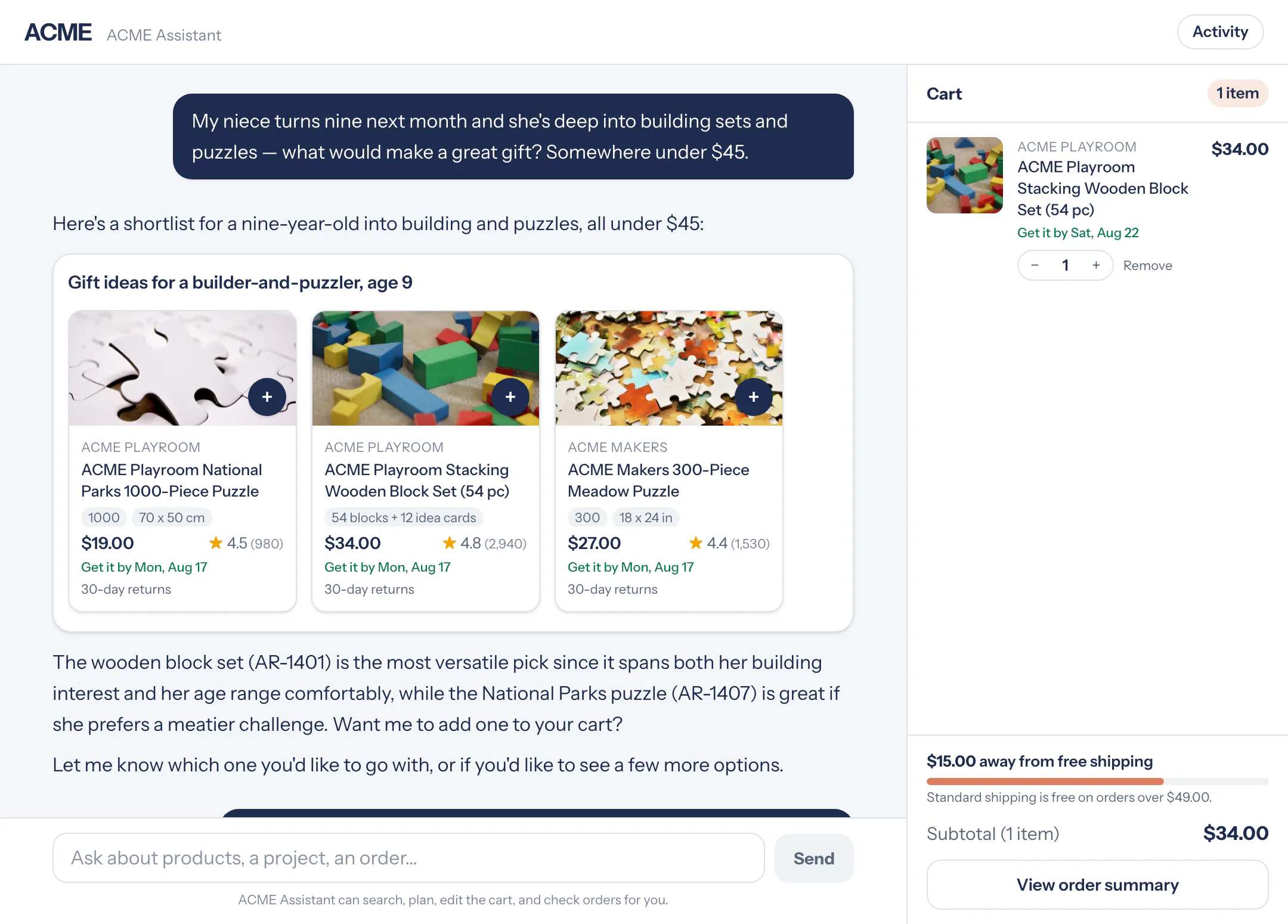
Anthropic's reference implementation includes a shopper agent designed for conversational checkout assistance and a merchant agent intended to help team members manage sales and inventory data. [2] The agents allow customers to find, compare, and check out directly within a retailer's application without relying on third-party assistants. [3] Retailers are implementing these tools to ensure shoppers comparing prices and availability do not migrate to external AI platforms for decision-making. [6]
The blueprint supports merchant agents that propose pricing and inventory changes while keeping a human in the final approval step. [6] These merchant agents are designed to catch price drift, update catalogs, and draft promotions. [3]
Deployment flexibility and performance metrics
The implementation is available on GitHub and deploys where developers currently build with Claude, such as the Claude API, Amazon Bedrock, Microsoft Foundry, or Google Cloud Vertex AI. [7] The repository provides implementations that can be built using the Messages API or Agent SDK. [7] An associated plugin for Claude Code will accompany the launch. [2]
Retailers using Claude for shopping agents have seen cart sizes increase by up to 35 percent. [7] Additionally, shoppers using these agents are 60 percent more likely to complete a purchase. [7] According to Adobe Analytics, AI-driven retail visits convert at a 60 percent higher rate than other traffic. [6] Anthropic partnered with Accenture, Mastercard, and Visa to enable clients to leverage the new agentic commerce capabilities. [2][7] Shopify is also integrating Claude’s capabilities into offerings for its clients. [2]
Translation tools for API traffic
Developers face integration challenges because Claude Code utilizes the Anthropic Messages API while tools like Codex CLI use OpenAI's format, and backend models may sit behind systems like NVIDIA NIM. [8] To manage multiple language models, developers can utilize NVIDIA's new Switchyard, a Rust proxy and library that translates requests between the OpenAI and Anthropic API formats. [8]
The software decodes inbound requests, selects a backend using a routing algorithm, and re-encodes the request into the appropriate format for the selected provider. [8] Switchyard accepts OpenAI Chat Completions, OpenAI Responses, and Anthropic Messages as inbound formats. [8] Switchyard is released under the Apache 2.0 license. [8] NVIDIA labeled the tool pre-alpha and experimental, warning that it is not intended for production use. [8]
What it means
Anthropic’s release of pre-packaged commerce blueprints signals a clear attempt to compete with Google and OpenAI in agentic commerce ahead of the holiday shopping season. By providing direct, customizable implementations for high-value retail operations, Anthropic is trying to lower the deployment barrier for enterprise clients while keeping transactions native to the retailer's app rather than ceding ground to external chatbots. Furthermore, NVIDIA's release of translation layers like Switchyard illustrates the growing necessity for multi-model interoperability, allowing developers to route traffic across disparate APIs seamlessly when rewriting agents is not feasible. What the sources don't address: how retailers will manage the engineering overhead of securely integrating these non-deterministic agent loops with legacy inventory, pricing, and fulfillment systems during high-traffic periods.
The introduction of pre-built agent architectures drastically reduces the time required to build consumer-facing commerce bots. Meanwhile, standardizing API routing between Anthropic and OpenAI formats via tools like Switchyard mitigates vendor lock-in for enterprise AI deployments.
Why it matters
Turn this story into practical AI skill after launch.
Get the release link for daily sessions built around your role and industry.
Join the waitlistHow this developed
3 September 2026
Anthropic Releases Agentic Commerce Blueprints as NVIDIA Previews Multi-API Translation Layer
3 September 2026
Event created from source cluster.
Sources
- Meet Switchyard: A Rust Proxy and Library That Routes and Translates LLM Traffic Across OpenAI and Anthropic APIsMarkTechPost
- Anthropic launches AI agent blueprints for retailers ahead of holiday shopping season - SRN Newssrnnews.com
- Anthropic debuts Claude features focused on agentic commercedigitalcommerce360.com
- Build commerce agents with Claude | Claude by Anthropicclaude.com
- Anthropic launches AI agent blueprints for retailers ahead of holiday shopping seasonin.marketscreener.com
- Anthropic Hands Retailers Claude Blueprints For Shopping Agents - Finimizefinimize.com
- Building commerce agents with Claudeclaude.com
- A guide to the anatomy of effective commerce agentsclaude.com