NVIDIA outlines Cosmos tools for interactive simulation
NVIDIA describes Cosmos Framework as an open, modular framework for developing world models for physical AI. The NVIDIA Developer Blog’s quoted date is Nov. 2, 2026.
Key takeaways · 4
- 01
Cosmos Framework is intended to support the full world-model development lifecycle, according to NVIDIA.
- 02
Developers can adapt models with LoRA or full supervised fine-tuning and train using JSONL, WebDataset, LeRobot or custom data adapters.
- 03
Simulation recipes cover multi-camera driving, robotics, scene generation and surgical policy evaluation.
- 04
NVIDIA says Cosmos NIM supports GPU-accelerated serving through application APIs.
A framework for model development
NVIDIA describes Cosmos as a platform of world foundation models and development tools for physical AI.[1] Cosmos Framework is presented as an open, modular framework for the full world-model development lifecycle, with agent skills and recipes for training, multimodal data processing, optimization and inference.[1] NVIDIA says it supports models beyond Cosmos 3, naming Alpamayo, GR00T, Qwen, pi0.5 and compatible Hugging Face models.[1] Cosmos Framework is described as a development framework, while Cosmos is described as a platform of world foundation models and development tools.[1]
Adaptation and training options
Developers can use either LoRA adaptation or full supervised fine-tuning, NVIDIA says.[1] For training data, the framework accepts JSONL, WebDataset and LeRobot, as well as custom data adapters.[1] NVIDIA also lists offline DPO and online GRPO pipelines, with rule-based or model-based rewards and vLLM rollouts.[1] Distillation and quantization are available to reduce model size, generation steps or memory use.[1] Together, these options give teams multiple routes to adapt and optimize models, though the post’s listed capabilities do not establish which approach will work best for a particular deployment.[1]
Interactive simulation examples
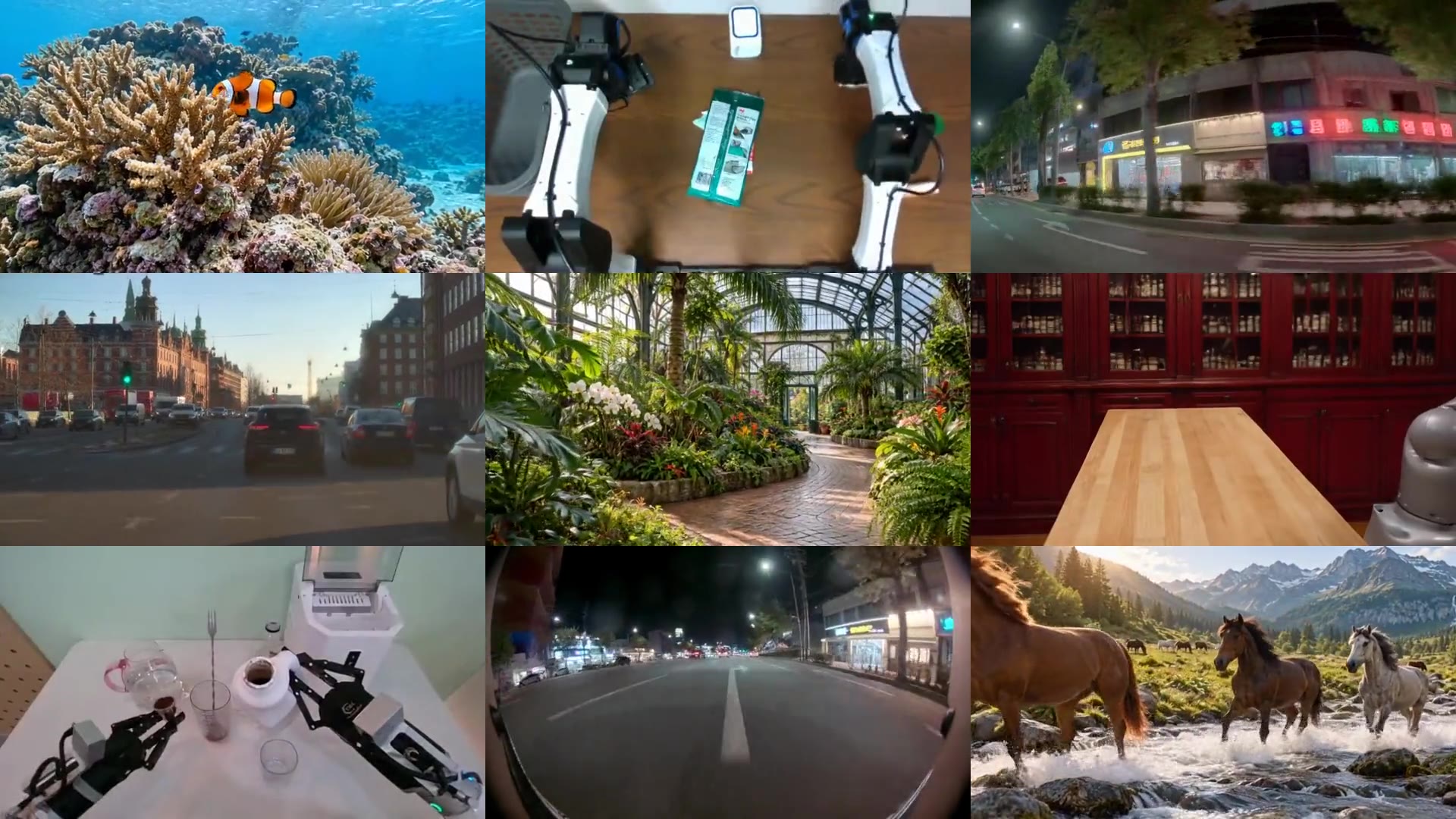
NVIDIA lists simulation recipes for robotics, scene generation, multi-camera driving and surgical policy evaluation.[1] Its new Cosmos 3 Nano recipes and example checkpoints are intended to let developers assess those examples and adapt them to custom sensors, action spaces and data domains.[1] A walkthrough uses released checkpoints to generate synchronized camera video and LiDAR observations for autonomous-vehicle, robotics and surgical scenarios.[1] The quoted specifications state support for 30-fps input and output video, with up to 400 frames at 480p or 720p.[1] NVIDIA reports one reference Transfer-Auto run generated seven 720p videos, each 297 frames at 30 fps, and 99 LiDAR sweeps.[1]
What the simulations do
For driving scenarios, observations are generated incrementally as an autonomous-vehicle policy or human driving input updates the scenario through a WSM renderer.[1] Another workflow converts depth video and a prompt into RGB video, varying lighting, textures and backgrounds while preserving geometry and motion.[1] Robotics recipes generate the next visual observation from the scene and robot actions, and support interactive two-arm simulation for YAM and AgiBot embodiments controlled by a policy or human-operated joysticks.[1] Surgical recipes can generate video from robot actions, predict actions from video, or generate both together.[1] NVIDIA describes the model as causal and few-step, generating frames from live robot kinematics for real-time, closed-loop simulation.[1]
Serving and reported results
Cosmos NIM microservices support GPU-accelerated serving through application APIs.[1] NVIDIA reports mean speculative-decoding speedups of roughly two to three times on H200 GPUs, and says streaming video-language-model inference can enable sub-second alerts with 10-times-lower latency.[1] NVIDIA also says Cosmos NIM provides automatic configuration selection, validated performance and quality across supported GPUs, licensing support and quarterly updates.[1] Separately, NVIDIA says Sim-Bimanual achieved higher video quality and reference-frame PSNR than DreamDojo 2B and 14B on two AgiBot benchmarks.[2]
Teams building simulations can assess whether the framework’s model, data and adaptation options fit their workflows before committing to a deployment. The combination of interactive scenarios and API-based serving makes evaluation of both simulation behavior and inference requirements a useful next step.
Why it matters
Bring this to your team — one session a day, built for your industry.
kju.ai is built for teams: daily sessions, team analytics, and rollout support for your organization.
For teamsHow this developed
3 November 2026
NVIDIA outlines Cosmos tools for interactive simulation
Sources
- Build World Models for Interactive Simulation with NVIDIA Cosmos | NVIDIA Technical Blogdeveloper.nvidia.com
- Interactive World Simulation with Cosmos for Physical AI — Cosmos Labresearch.nvidia.com
- nvidia/Cosmos3-Nano-Sim-Bimanual · Hugging Facehuggingface.co