NVIDIA adds four open Cosmos 3 simulation checkpoints
NVIDIA says it has added four open-weight checkpoints to its Cosmos 3 family for interactive world simulation and multi-sensor, multi-view driving scenes. The Hugging Face article announcing them was published November 5, 2026.
Key takeaways · 5
- 01
The release comprises four open-weight, 16-billion-parameter Cosmos 3 Nano checkpoints.
- 02
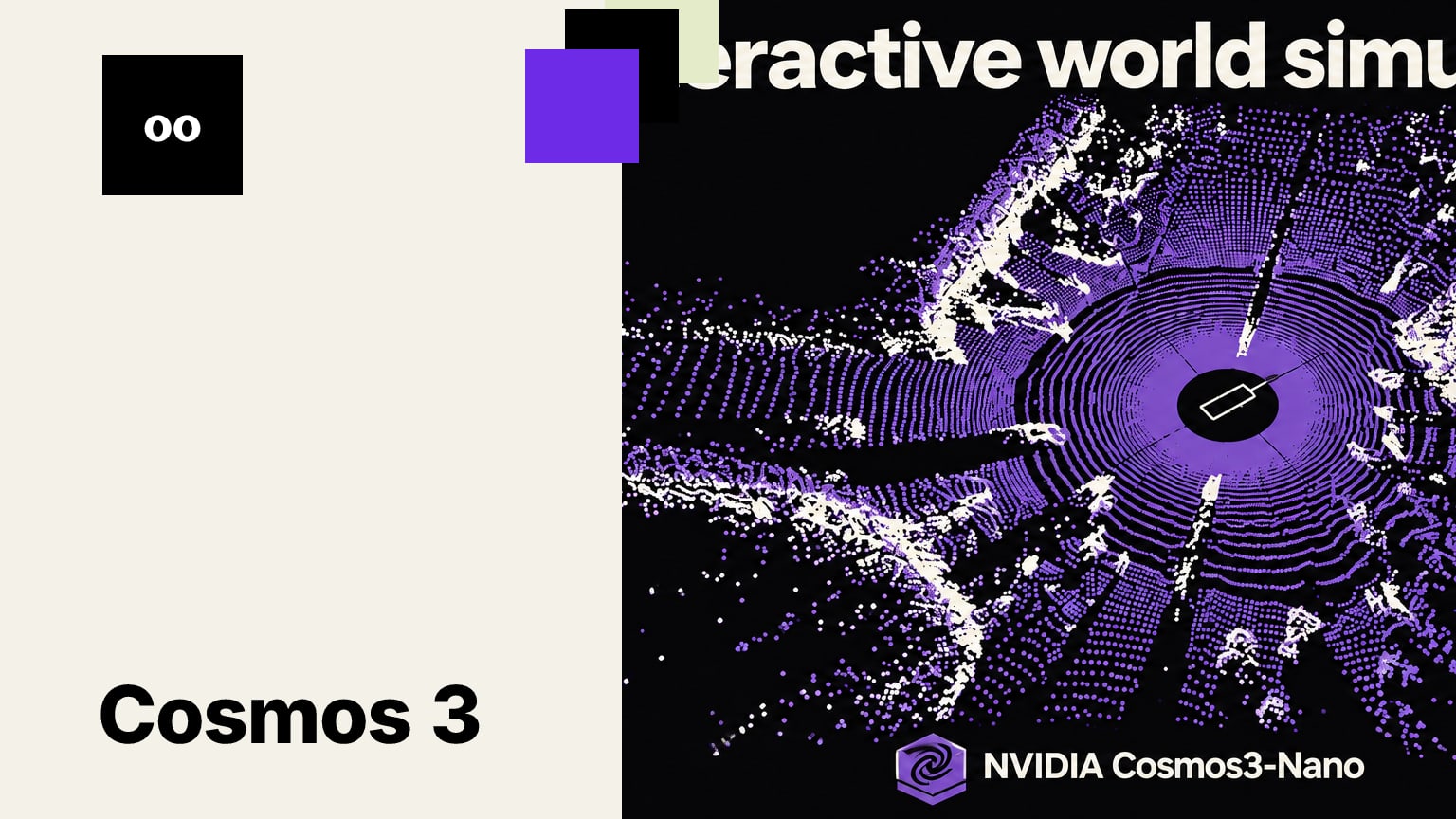
Transfer-Auto can produce synchronized video across as many as 11 camera views and jointly generate RGB and LiDAR.
- 03
Sim-Auto supports streaming camera and LiDAR observations, but NVIDIA says closed-loop interaction requires a simulation runtime and WSM renderer.
- 04
Sim-Bimanual supports interactive two-arm simulation for YAM and AgiBot embodiments, controlled by a policy or human-operated joysticks.
- 05
NVIDIA says more work is needed to measure support for policy learning and evaluation and to understand the models’ limits.
Four checkpoints for different simulation tasks
NVIDIA says the four additions are open-weight, post-trained Cosmos 3 Nano examples, each with 16 billion trainable parameters.[1] The set includes Cosmos3-Nano-Transfer-Auto and Cosmos3-Nano-Sim-Auto for driving scenes, Cosmos3-Nano-Sim-Transfer for turning simulator controls and text into video, and Cosmos3-Nano-Sim-Bimanual for robot-action video prediction.[1] NVIDIA says the models use OpenMDW1.1, whose terms permit commercial and non-commercial use.[1] Teams evaluating them should check those terms and match a checkpoint to the task they want to test.
Driving outputs span cameras and sensors
Transfer-Auto generates multi-view driving data with varied weather, lighting, and time of day.[1] It can generate synchronized video for as many as 11 camera views, including fisheye views, and supports joint RGB and LiDAR generation.[1] Sim-Auto instead streams synchronized camera and LiDAR observations for driving simulation.[1] It generates successive video and LiDAR chunks in a few denoising steps, using generated history and updated driving controls to support fast streaming and long interactive rollouts.[1] These distinctions give engineering teams a basis for deciding which workflow to test first.
Interactive use has integration requirements
NVIDIA says Sim-Auto requires a simulation runtime and WSM renderer to update controls for closed-loop interaction.[1] Its generator predicts each short segment from the prompt, available controls, and generated history.[1] The separate Sim-Transfer checkpoint turns simulator controls and a text prompt into photorealistic video.[1] For robot simulation, Sim-Bimanual predicts video from robot or camera actions and supports two-arm YAM and AgiBot embodiments, controlled by a policy or human-operated joysticks.[1] Its example can switch between viewpoint changes and manipulation within one control sequence.[1]
Open weights do not settle model limits
NVIDIA says the open weights and post-training recipes offer a shared starting point for adaptation, comparison, and contributions.[1] It also says further work is needed to measure how faithfully the models support policy learning and evaluation and to understand their limits.[1] The listed requirements are Linux, an NVIDIA GPU, Docker, and NVIDIA Container Toolkit.[1] NVIDIA says its published vLLM-Omni setup was tested on one GB200, while noting that this is not a minimum-memory specification.[1] The post prompts readers to download the checkpoints.[1] Teams should treat their own testing as necessary before relying on a model for evaluation.
For engineering teams, the release offers several open-weight starting points for testing interactive driving and robot-simulation workflows. The stated integration requirements and NVIDIA’s caveat about further evaluation make it important to separate access to model weights from evidence of performance for a specific use.
Why it matters
AI training for your team
kju.ai is built for teams: daily sessions, team analytics, and rollout support for your organization.
How this developed
25 November 2026
NVIDIA adds four open Cosmos 3 simulation checkpoints