Lean and Mathlib communities confirm Alpöge’s Riemann Hypothesis proof
The Lean and Mathlib communities said the Riemann Hypothesis statement and proof in Alpöge’s Lean library are correct. Their joint statement was published on November 21, 2026, one day after Alpöge released the library.
Key takeaways · 4
- 01
Alpöge released the Lean library on November 20, 2026; the Lean and Mathlib communities published their joint statement the following day.
- 02
The verification confirmed that the theorem matches Mathlib’s Riemann Hypothesis statement.
- 03
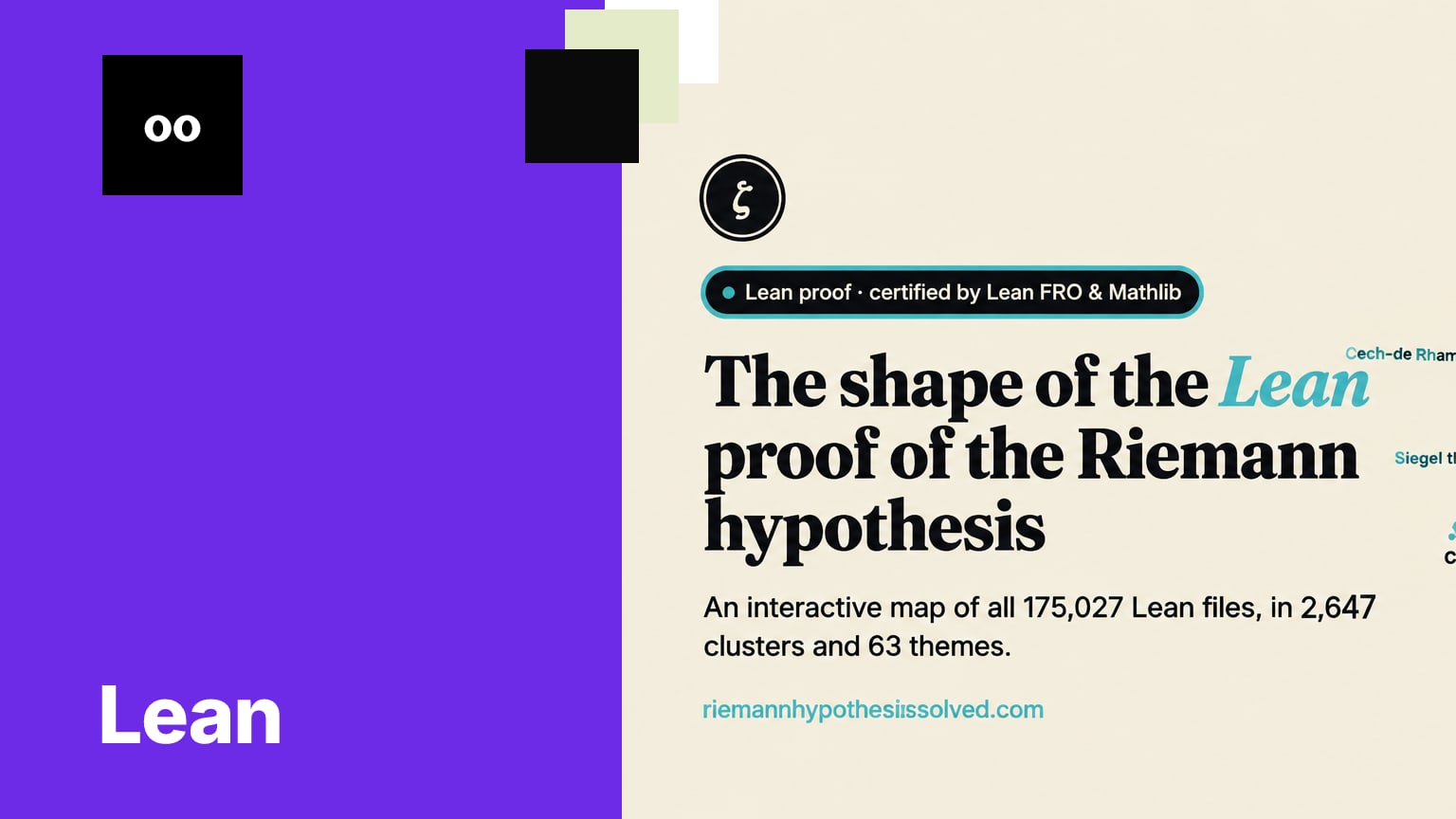
The archive contains 175,187 Lean files and 17,374,215 lines of code.
- 04
The verified generalization covers Dirichlet L-functions for every modulus and character, but not several other broad classes of L-functions.
What the communities confirmed
Alpöge released the proof as a Lean library on November 20, 2026.[1] On November 21 at 13:55 UTC, the Lean and Mathlib communities published a joint statement, endorsed by the Lean Focused Research Organization and the Mathlib Initiative.[2][1] They said both the theorem statement and proof are correct, and confirmed that Alpöge’s theorem is exactly Mathlib’s statement of the Riemann Hypothesis.[1] The library compiled without errors, and dozens of people reported reproducing the same raw proof export file.[1]
What was checked
The archive contains 175,187 Lean files and 17,374,215 lines of code.[2] Several proof checkers checked the exported proof, including Lean’s official kernel and the con-leche and con-ron checkers.[1] An independent sandboxed rebuild on another machine produced an export identical to the published one, and the export was also accepted by nanoda, an independent Rust proof kernel.[5] The five headline theorems depend only on three standard axioms.[5]
Scope and the next step
The result concerns the Riemann Hypothesis, proposed by Bernhard Riemann in 1859 and concerning the distribution of prime numbers.[6] Alpöge’s note says the proof method also resolves the Generalized Riemann Hypothesis and may, with further work, extend to the Extended Riemann Hypothesis.[4] The verified generalization covers Dirichlet L-functions for every modulus and character, but does not generally cover Dedekind zeta, Hecke or automorphic L-functions.[5] Alpöge says he intends to understand and explain the argument and write it up properly; the Lean and Mathlib communities also look forward to mathematical work explaining its new ideas.[4][1]
For people working with formal verification, the report offers a concrete example of a mathematical result checked through a large Lean library and multiple proof checkers. The next useful step for many readers will be an explanatory account of the argument, alongside the machine-checked result.
Why it matters
AI training for your team
kju.ai is built for teams: daily sessions, team analytics, and rollout support for your organization.
How this developed
22 November 2026
Lean and Mathlib communities confirm Alpöge’s Riemann Hypothesis proof
Sources
- Lean verification of the Riemann Hypothesis | Lean community blogleanprover-community.github.io
- Has the Riemann hypothesis been solved? Status 22 Nov 2026riemannhypothesissolved.com
- Two groups verify mathematician’s claim that Claude helped prove mathematics problem | Anthropic | The Guardiantheguardian.com
- 1https://alpo.ge/lean.tar.gz.part01, . . . , https://alpo.ge/lean.tar.gz.part14.alpo.ge
- RH Lean proof: verification filesmath.mit.edu
- The AI Riemann hypothesis proof is true, independent mathematicians confirm | Scientific Americanscientificamerican.com