Databricks Unveils Agentic Upgrades to Lakeflow Data Engineering Platform
Databricks announced the next evolution of its Lakeflow platform at the Data + AI Summit, introducing new agentic tools for data pipeline creation and operation.
Key takeaways · 3
- 01
Lakeflow unifies data engineering tasks from ingestion to orchestration under Unity Catalog governance.
- 02
Genie Code automates the creation of ingestion connectors and job development.
- 03
Lakeflow Designer is now generally available, enabling no-code ETL pipeline building via natural language.
Agentic Platform Evolution
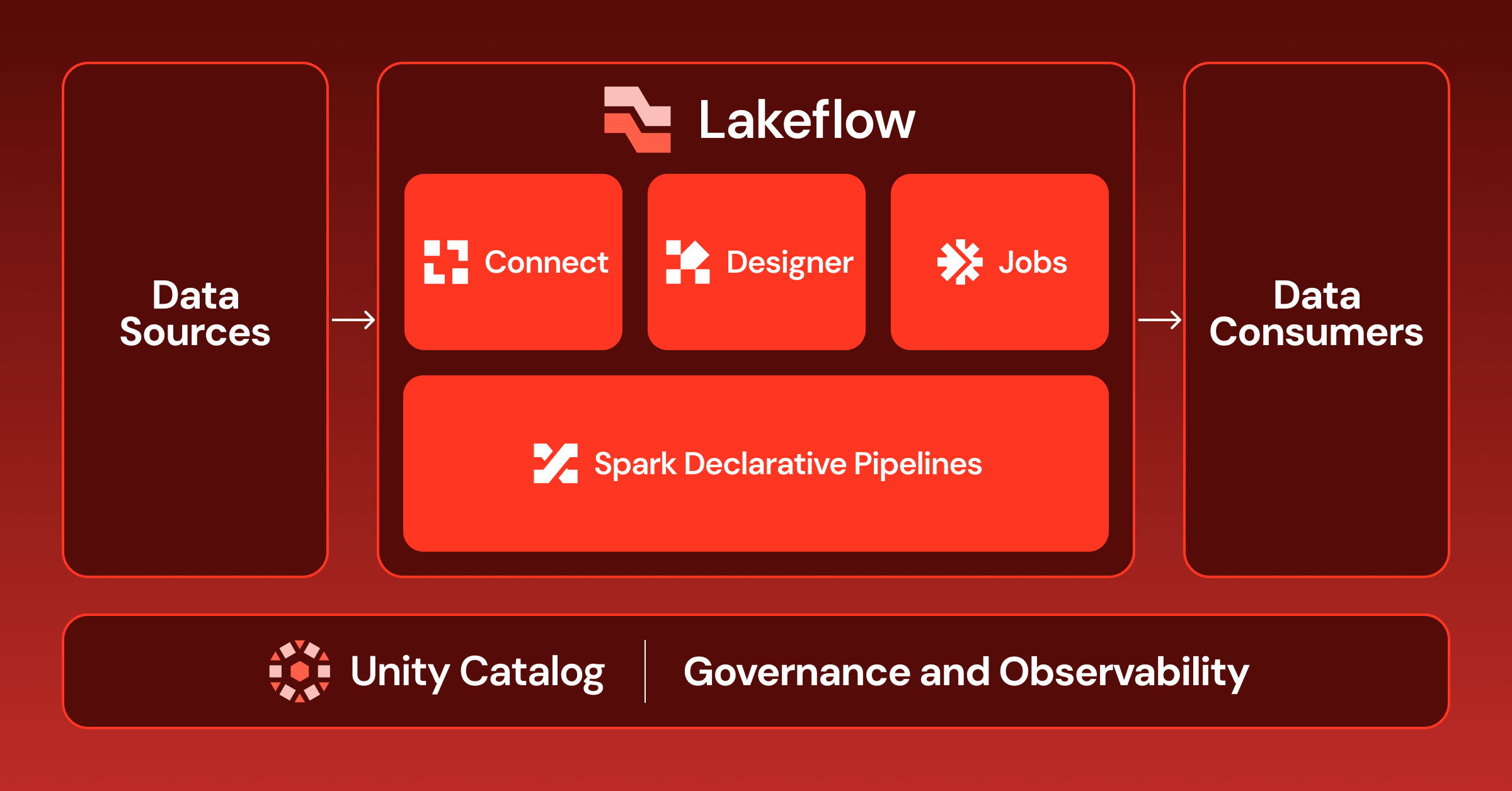
Databricks announced the next major evolution of Databricks Lakeflow at the Data + AI Summit. [1] Lakeflow is a unified platform for data engineering from ingestion, to transformation and orchestration. [1] All Lakeflow capabilities are fully integrated and centrally governed by Unity Catalog. [1] This unified architecture enables agents not only to build but also to operate data pipelines. [1]
Genie Code and Designer
Users can use Genie Code to create ingestion connectors, build pipelines in Python and SQL and develop jobs with tasks, triggers and dependencies. [1] Now generally available, Lakeflow Designer empowers teams to develop pipelines using a drag-and-drop canvas and natural language prompts. [1] Business analysts and non-technical users can build production-ready ETL pipelines without writing code. [1] Every visual Flow built in Designer natively runs on a production-ready Spark Declarative Pipeline. [1]
What it means
The launch of Lakeflow Designer targets a persistent challenge in enterprise data management by enabling non-technical users to build ETL pipelines natively on Spark without writing code. By integrating agentic capabilities directly into ingestion and orchestration workflows, Databricks aims to simplify complex, fragmented data stacks that have historically required extensive manual maintenance across a range of use cases and user personas. The native translation to Spark Declarative Pipelines also bridges the gap between business analysts and data engineers, allowing the latter to review generated code directly in place without switching context. What the sources don't address: How the pricing and consumption structure will change for existing customers adopting these newly integrated agentic automation features.
The shift toward agentic data engineering lowers the technical barrier for creating robust data pipelines. This allows enterprises to consolidate fragmented data stacks and rely on AI agents for end-to-end pipeline operation and orchestration.
Why it matters
Put this to work — one session a day, built for your industry.
Create a free account for a daily session — eight questions and one real-work challenge, on the news that affects your role.
Start freeHow this developed
16 June 2026
Event created from source cluster.