Hangang supercomputer enters trial service in South Korea
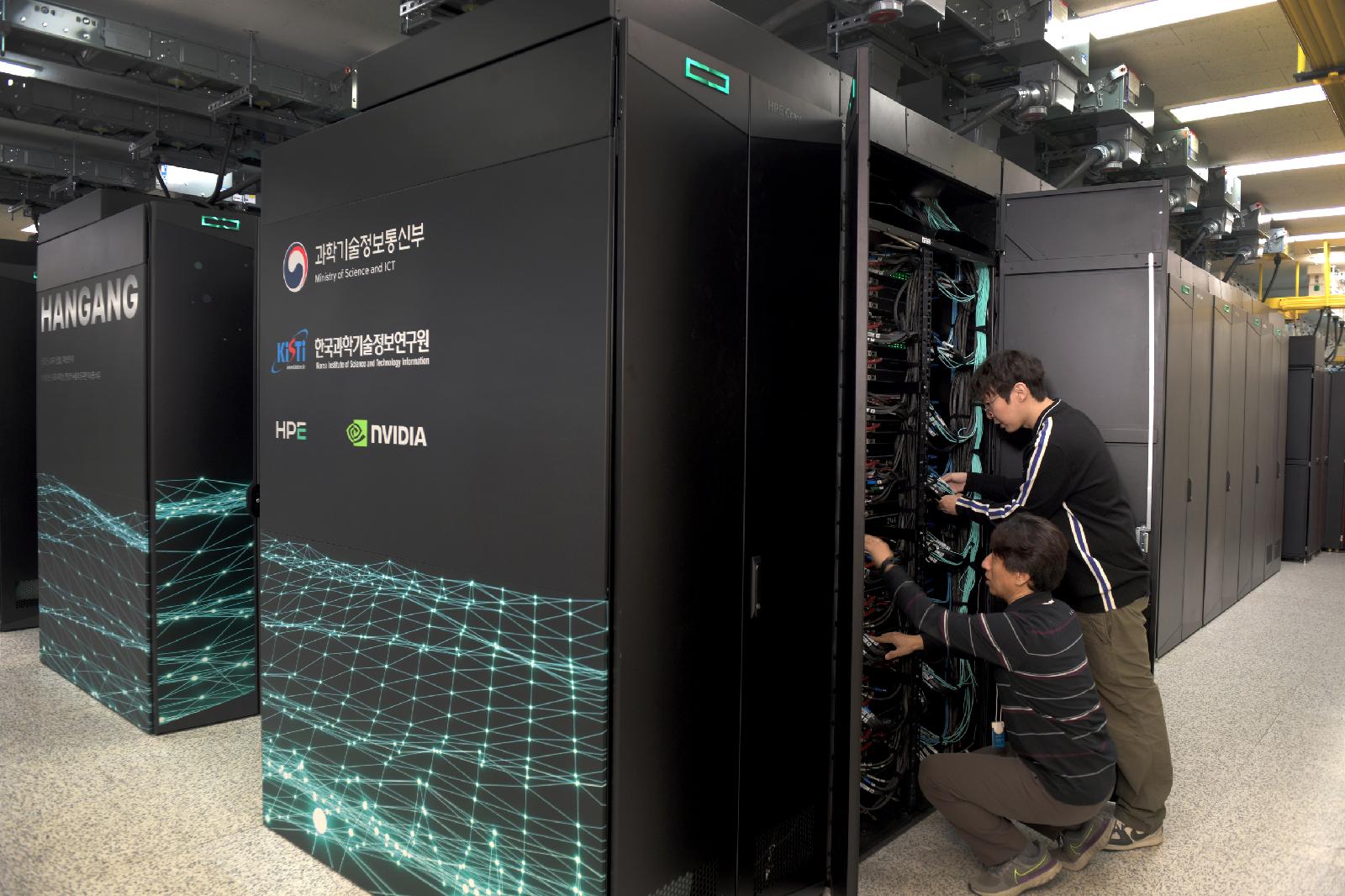
South Korea’s Ministry of Science and ICT and the Korea Institute of Science and Technology Information held an inauguration ceremony for the Hangang supercomputer in Daejeon on the 2nd. KISTI is running a trial service, with official service scheduled to begin on the 14th of next month.
Key takeaways · 4
- 01
Hangang is in trial service now, with official service scheduled for the 14th of next month.
- 02
Its intended research uses include AI-based drug-candidate discovery and new-material development.
- 03
The government plans to allocate around 15% of its computing resources to industrial innovation.
- 04
SMEs and startups are to receive technical support, consulting and computing resources.
Research uses and priority fields
Hangang is designed for AI-based scientific research alongside large-scale computation and simulation.[1] Its intended uses include discovering drug candidates with AI and developing new materials.[1] KISTI lists biotechnology, materials and chemistry, earth sciences, and semiconductor research among its priority areas.[4] That range positions the system as shared infrastructure for research across several scientific and technical disciplines, rather than a resource intended for a single field. The announced uses describe the system’s purpose; the evidence does not report completed research outcomes from Hangang.
How researchers and firms may access it
KISTI began recruiting researchers to use Hangang in September, and the system has been in a trial run since then.[3] KISTI is currently running a trial service, while official service is scheduled to begin on the 14th of next month.[1][2] The government plans to allocate around 15% of Hangang’s total computing resources to industrial innovation and around 55% to general R&D by universities and other academic, industrial and research institutions.[1] It plans to use about 30% of the resources remaining after the industrial-innovation allocation for national strategic R&D, including K-Moonshot.[1]
Support for smaller companies
The government plans to provide small and medium-sized enterprises and startups with technical support, consulting and computing resources.[1] Hangang is intended to help smaller firms carry out complex design work and simulations without purchasing their own expensive computing equipment.[1] For companies considering research or engineering workloads, those plans make access arrangements and technical assistance important details to check as the service moves from trial to official operation. The evidence describes planned support and intended use, but does not specify application procedures, eligibility rules or the amount of computing time available to individual firms.
Scale and national research context
Hangang was funded with 370 billion won in government investment.[1] According to KISTI and the Ministry of Science and ICT, it has 8,496 GPUs and 9,936 CPUs.[2] Its theoretical peak performance is 614 petaflops, and it has 205 petabytes of storage.[3] Compared with its predecessor Nurion, Hangang offers 24 times the theoretical computing performance, 10 times the storage capacity and four times the network performance.[3] The ministry expects Hangang to place in or near the Top500’s top 10; the ranking is due to be released at the SC26 conference in Chicago this month.[3]
For research and engineering teams, Hangang could offer access to substantial computing resources without requiring each organization to build its own infrastructure. The practical value will depend on access, support and workload fit, details that are not specified in the evidence.
Why it matters
Bring this to your team — one session a day, built for your industry.
kju.ai is built for teams: daily sessions, team analytics, and rollout support for your organization.
For teamsHow this developed
3 November 2026
Hangang supercomputer enters trial service in South Korea
Sources
- 370 Billion Won Supercomputer Hangang Begins Operation; to Be Used for AI Drug Discovery and More - MKmk.co.kr
- 국가 슈퍼컴 6호기 '한강' 본격 가동…연산성능 24배↑ - 정책뉴스 | 뉴스 | 대한민국 정책브리핑korea.kr
- Korea's sixth national supercomputer, Hangang, begins runningkoreajoongangdaily.com
- KISTI Expands AI and HPC Collaboration with NVIDIA and HPE Based on Supercomputer No. 6 “HANGANG” | KISTI News | What's New | KISTIkisti.re.kr