Google-led team introduces StreamVibe video agent
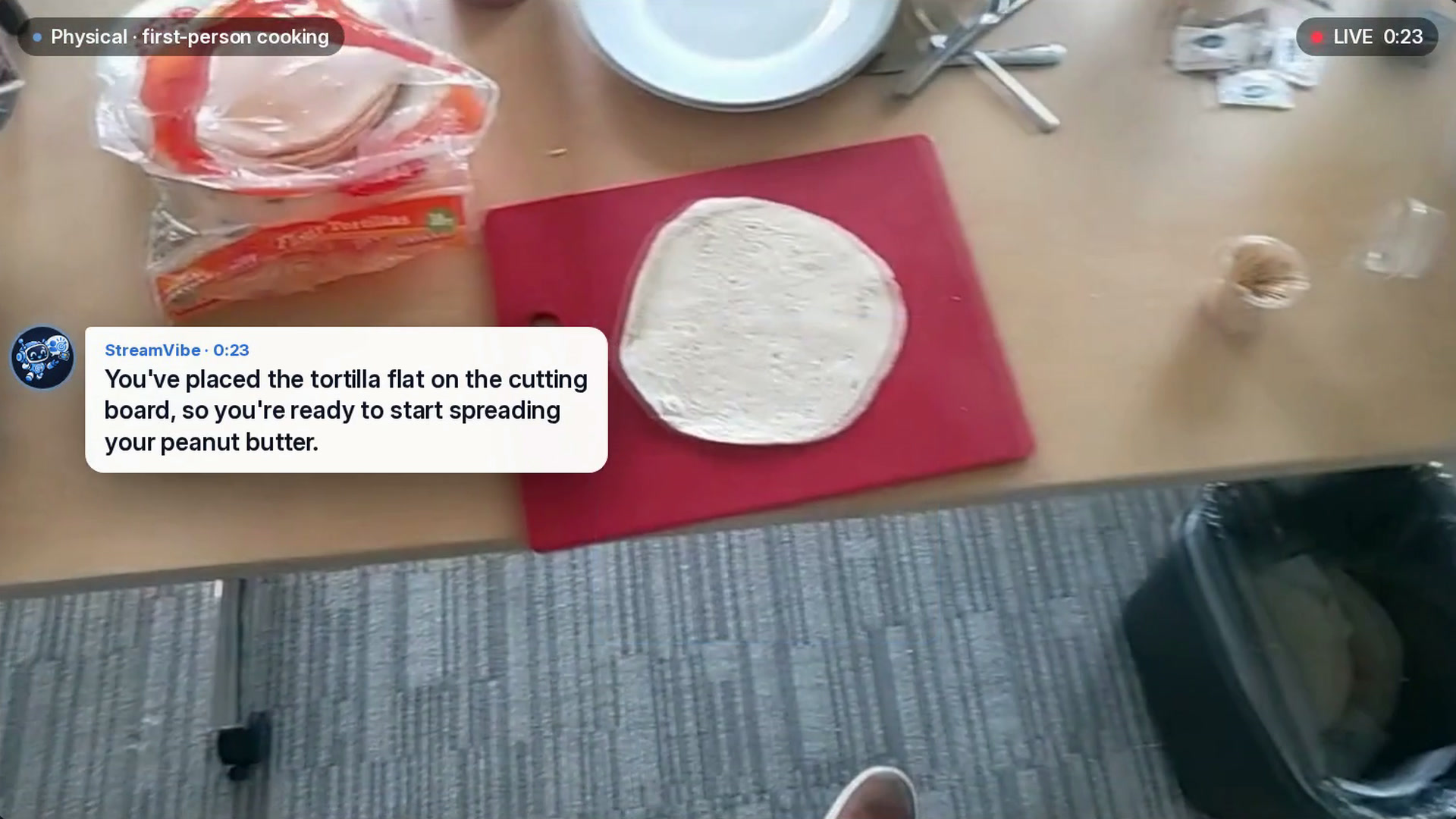
A Google-led research team introduced StreamVibe, a video agent designed to decide when to speak during activities such as cooking or assembling furniture. The system aims to infer users’ intentions and adapt as those intentions change.
Key takeaways · 4
- 01
StreamVibe-VL decides each second whether to stay silent or respond.
- 02
StreamVibe-Bench has 4,100 evaluation samples and 85,000 training samples, drawn from 183.4 hours of video.
- 03
The researchers report gains of 10.7% for StreamVibe-VL and 12.3% for StreamVibe-Harness on their respective measures.
- 04
The Decoder reports that response timing often failed on videos longer than five minutes, and performance dropped as errors compounded.
A video agent built around timing
StreamVibe is designed to help during activities including cooking and assembling furniture, where an agent may need to decide whether to offer guidance.[1] Its research team includes researchers from Google, Stanford, Oxford and several U.S. universities.[1] The paper separates user intent into explicit, implicit and dynamic categories.[2] That distinction matters to the system’s stated aim: infer what a person needs even when they have not directly asked, then adjust as their intentions shift.[2] The Decoder reported on the research on Nov. 1, 2026.[1]
How the system and benchmark work
StreamVibe-VL makes a decision every second about whether to remain silent or respond.[1] A second component, StreamVibe-Harness, maintains user intentions as persistent states using hierarchical memory.[2] The team’s StreamVibe-Bench contains 4,100 evaluation samples and 85,000 training samples, based on 183.4 hours of video.[2][3] Its evaluation set includes 600 explicit-intent samples, 2,000 implicit-intent samples and 1,500 dynamic-intent samples.[3] Four reviewers had to approve a sample unanimously for it to be retained.[3]
Reported gains—and a comparison
The researchers report that StreamVibe-VL improved response timing and answer quality by 10.7% over existing baselines, while StreamVibe-Harness improved proactive interaction performance by 12.3%.[2] The paper also says StreamVibe-VL preserves strong general video-understanding capabilities.[2] These are reported research results, not evidence that the system is ready for every work setting. In The Decoder’s account, Google’s proprietary Gemini 3.8 Flash outscored StreamVibe-VL in several tests.[1] The comparison underscores that the reported gains do not mean StreamVibe led every evaluation.[2][1]
Long-video limits remain
The Decoder reports that performance across all tested systems plummeted in continuous video evaluation as errors compounded.[1] A key content metric for responses fell by as much as 61.5% when systems relied on their own prior history.[1] Models rarely chose the right moment to respond in videos longer than five minutes, and the researchers say they struggle particularly with instructions that change during long videos.[1] Examples included JoyAI saying a GIMP image had been saved before the user opened it, and StreamVibe-VL advising someone to cut off a jam-roll’s bread crust first.[1] The researchers caution that real-world situations may be more complex than their test setup.[1]
For teams building or evaluating video assistants, the work makes response timing and changing user intent explicit evaluation targets. The reported gains are promising research results, but the long-video failures and real-world caveat argue for testing against the actual duration, context and user needs of a deployment.
Why it matters
Bring this to your team — one session a day, built for your industry.
kju.ai is built for teams: daily sessions, team analytics, and rollout support for your organization.
For teamsHow this developed
2 November 2026
Google-led team introduces StreamVibe video agent