Google expands its TPU lineup for secure inference and long contexts
Google says it introduced four TPU systems in a single year, including configurations aimed at confidential inference and large context windows. The systems are configurations of existing silicon, rather than entirely new chip designs.
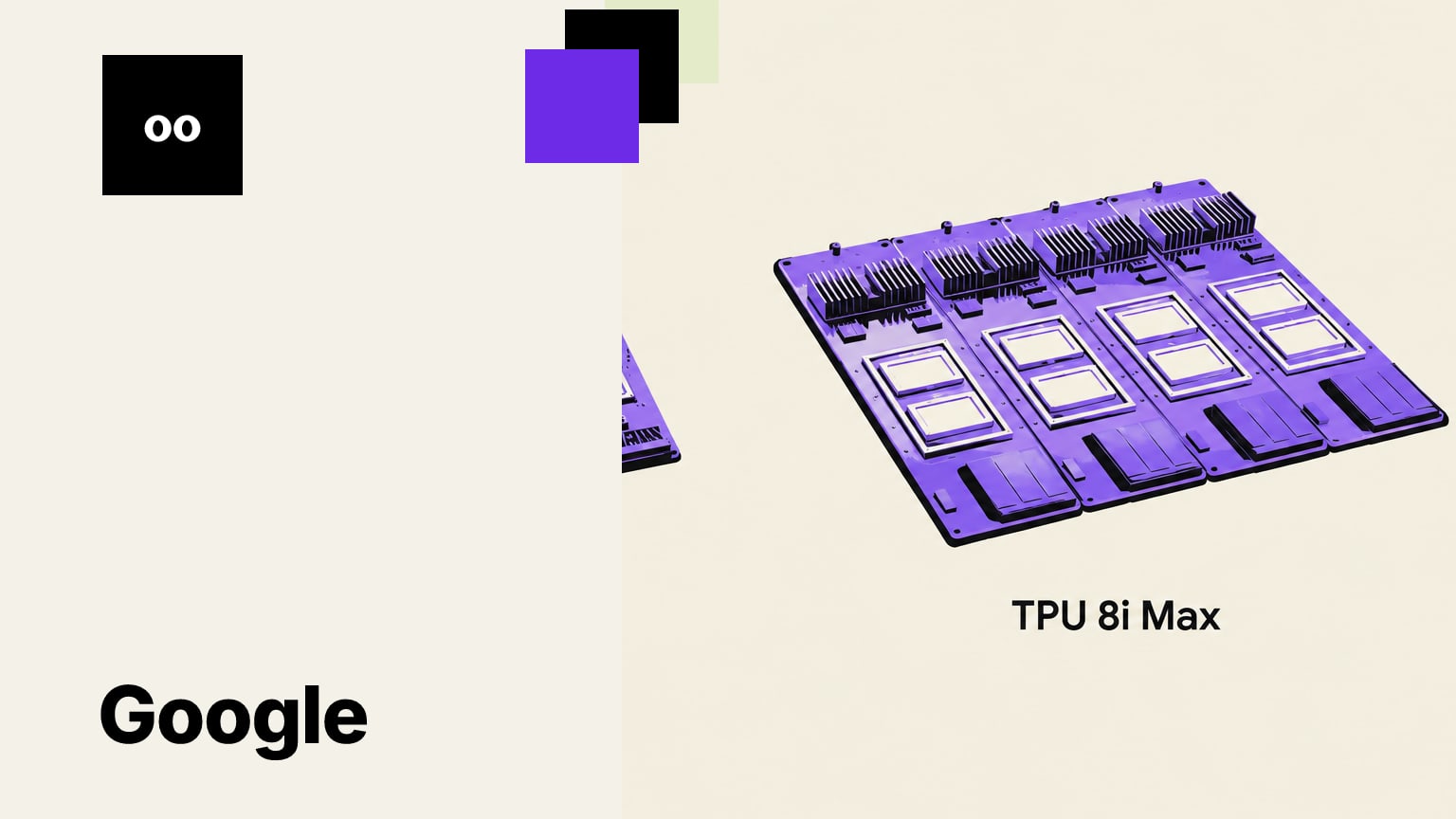
Key takeaways · 4
- 01
TPU 8tx is aimed at regulated businesses and government agencies handling sensitive information.
- 02
Google says TPU 8i Max has double the compute, SRAM and HBM bandwidth of TPU 8i.
- 03
Google says customers can access TPUs through Google Cloud or deploy them in their own data centers.
- 04
Google says all TPUs it had available were already contracted to customers.
Two configurations target different workloads
Google says TPU 8tx is designed for secure, confidential inference and small-scale training, with regulated businesses and government agencies among its target customers.[1] Google says the system protects sensitive data and model weights while they are in active use.[1] It also supports fine-tuning with private data, distillation and reinforcement learning for agents, according to Google.[1] Google says TPU 8i Max is designed for massive context windows and high compute density per rack.[1] The company built it by combining two low-latency TPU 8i chips in one package.[1]
Google describes performance gains
Google says TPU 8i Max has double the compute, SRAM and HBM bandwidth of TPU 8i.[1] For TPU 8tx, Google says it delivers up to twice the speed of its predecessor.[3] Google separately says TPU 8tx offers up to twice the latency reduction of TPU 8t, with a near-zero performance penalty.[1] Google says the new systems address demand for million-token context scale and hardware-level data security.[1]
Availability and customer access
Google said the variations would be available in 2027.[2] The company is offering TPUs to external customers through Google Cloud, and says customers can also deploy them directly in their own data centers.[3][1] Oracle said its cloud customers would be able to use Google TPUs starting in 2027.[2] Google says its TPU business has nearly 100 customers, including frontier labs, trading firms, retailers and universities.[1] Jump Trading has thousands of TPUs and uses them to train AI models for work such as trading research.[2]
Competition meets supply constraints
TPUs compete in a market dominated by Nvidia GPUs.[2] Google TPUs cost about 30% less than Nvidia GPUs while delivering competitive throughput, according to the evidence.[2] Google says every TPU it had available was already contracted to a customer.[2] The company also faces shortages of key components, including memory and manufacturing capacity.[2] These constraints matter alongside Google’s expansion beyond its own services: the company has traditionally used TPUs for Search, YouTube and Gemini.[3] Google Cloud revenue more than doubled to $30.71 billion in the September quarter, with TPU sales making a meaningful contribution, according to Alphabet.[3]
For teams weighing AI infrastructure, the announcement puts workload fit, data protection, access route and availability on the same decision checklist. Buyers should distinguish Google’s performance claims from independent testing and factor the stated 2027 timing and supply constraints into planning.
Why it matters
AI training for your team
kju.ai is built for teams: daily sessions, team analytics, and rollout support for your organization.
How this developed
15 November 2026
Google expands its TPU lineup for secure inference and long contexts
Sources
- Introducing TPU 8tx and TPU 8i Max | Google Cloud Blogcloud.google.com
- Google escalates Nvidia rivalry with new TPUs | The Straits Timesstraitstimes.com
- Google unveils new AI chips to challenge Nvidiaobserverbd.com