Goldman sees early signs of AI-related hiring headwinds
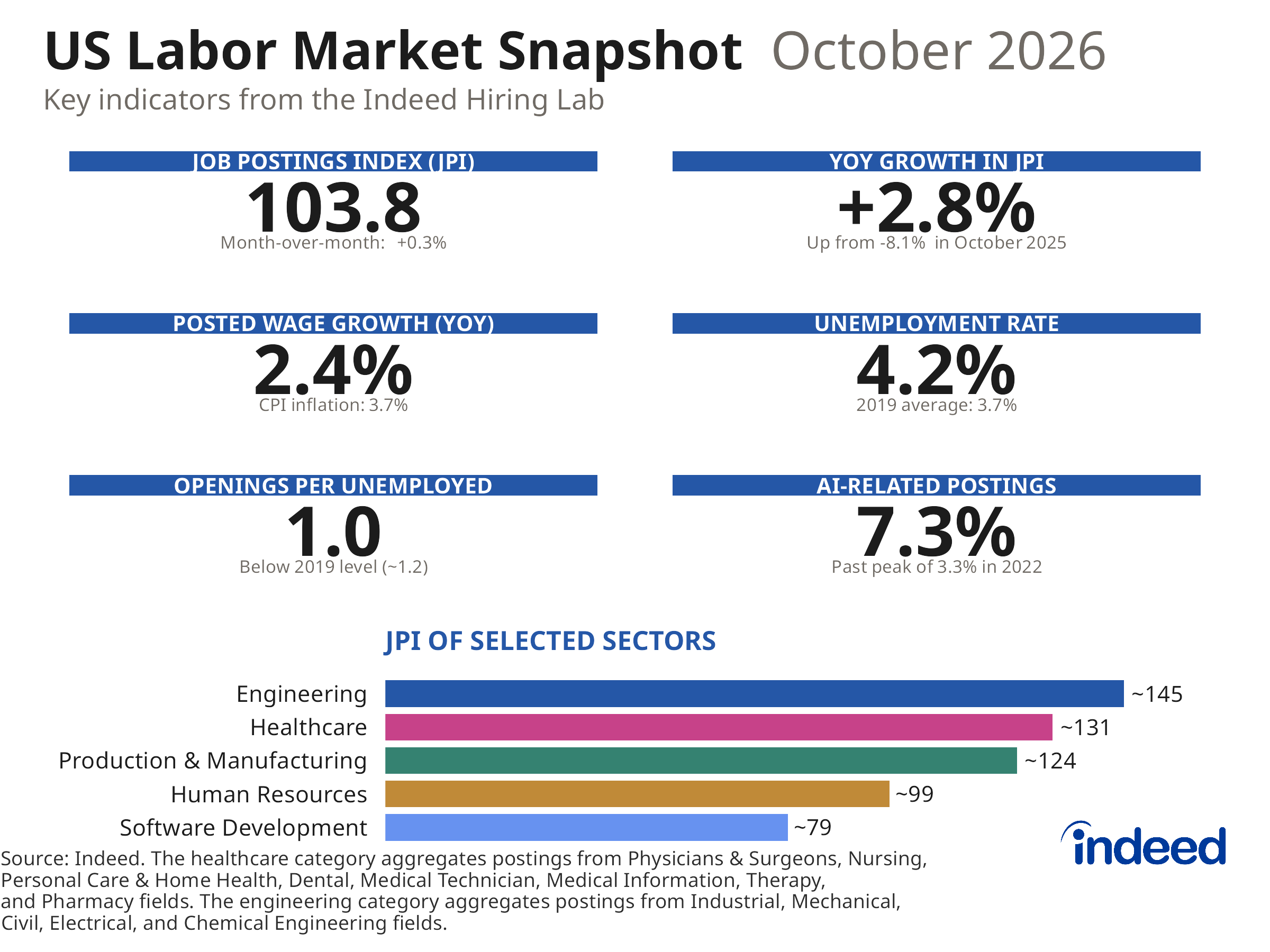
Goldman Sachs analysts say recent U.S. labor-market data show early signs that AI adoption is weighing on hiring, though the broader employment impact remains limited.
Key takeaways · 4
- 01
Goldman estimates employment growth in the most AI-exposed industries ran about 10,000 jobs below its long-term trend over the prior three months.
- 02
Hiring in AI-related construction largely offset that shortfall, according to Goldman.
- 03
Only 23% of U.S. establishments currently use AI in regular workflows, according to Goldman.
- 04
Goldman says junior workers may face greater hiring headwinds from AI adoption than other workers.
A small gap, partly offset
Goldman estimates employment growth in industries most exposed to AI was about 10,000 jobs below its long-term trend over the prior three months.[1] The analysts say increased hiring in AI-related construction largely offset that shortfall.[1] Their findings describe an employment impact that Goldman says remains limited so far.[1] The distinction matters for employers interpreting sector-level changes: the estimate is a comparison with a trend, and the construction hiring offset means the shortfall should not be read alone as the net effect across the economy.[1]
Evidence and economic context
Goldman’s analysis found a statistically significant positive relationship between AI adoption and unemployment across service industries, and a weaker negative relationship with employment growth.[1] The findings indicate an association; the evidence provided does not establish that AI alone caused the changes. Goldman's historical analysis found that each 1% increase in technology-driven productivity temporarily raised unemployment by 0.3 to 0.4 percentage points, with the effect fading after two years.[1] It also says automation-related disruption tends to be limited when the economy is healthy and accelerates during cyclical slowdowns.[2]
Forecasts are gradual, not uniform
Goldman’s baseline outlook anticipates a gradual increase in AI-related labor disruption rather than an abrupt employment shock as economic growth continues.[1] In a forecast assuming AI raises economy-wide productivity by 15%, Goldman estimates that up to 9% of workers could be displaced during the transition.[2] That is a conditional projection, not a current tally of displaced workers. Goldman’s historical review of 25 occupations disrupted by earlier technologies found average employment fell 25% over five years, with job losses accounting for most of the decline.[1]
Adoption and worker exposure
Goldman says 23% of U.S. establishments currently use AI in regular workflows, indicating that adoption is not yet universal.[1] Its cross-country analysis found that 10% occupational exposure to AI was associated with a 0.1-percentage-point drag on annual headcount growth in France, Canada and the United States.[3] France, the United States, the Netherlands and the United Kingdom sit at the top end of the AI-adoption range among developed markets.[3] Goldman also warns that junior workers may face greater hiring headwinds than other workers.[3]
For workforce planning, the evidence argues for monitoring hiring patterns by role and sector rather than treating AI’s labor effects as an economy-wide shock. Junior hiring may merit particular attention, and Goldman’s baseline expects disruption to build gradually.
Why it matters
Bring this to your team — one session a day, built for your industry.
kju.ai is built for teams: daily sessions, team analytics, and rollout support for your organization.
For teamsHow this developed
26 October 2026
Goldman sees early signs of AI-related hiring headwinds
Sources
- Recent labor market data show some signs of AI-related hiring headwindsfinance.yahoo.com
- AI could displace one in 11 workers, Goldman says, but the layoffs are waiting for a recession | Fortunefortune.com
- Is AI Impacting Global Labor Markets? | Goldman Sachsgoldmansachs.com
- Employment Situation News Release - 2026 M09 Resultsbls.gov
- US Labor Market Snapshot — October 2026 - Indeed Hiring Labhiringlab.indeed.com