Databricks Introduces Genie ZeroOps Autonomous Background Agent
Databricks has launched Genie ZeroOps, an autonomous background agent designed to monitor data and AI assets and remediate operational failures.
Key takeaways · 2
- 01
Leverage Genie ZeroOps sandbox environments to test agent-generated pipeline fixes against shallow-cloned production data safely.
- 02
Utilize Unity Catalog lineage tracking to automatically map dependency graphs and isolate the root cause of silent data failures.
The Firefighting Burden
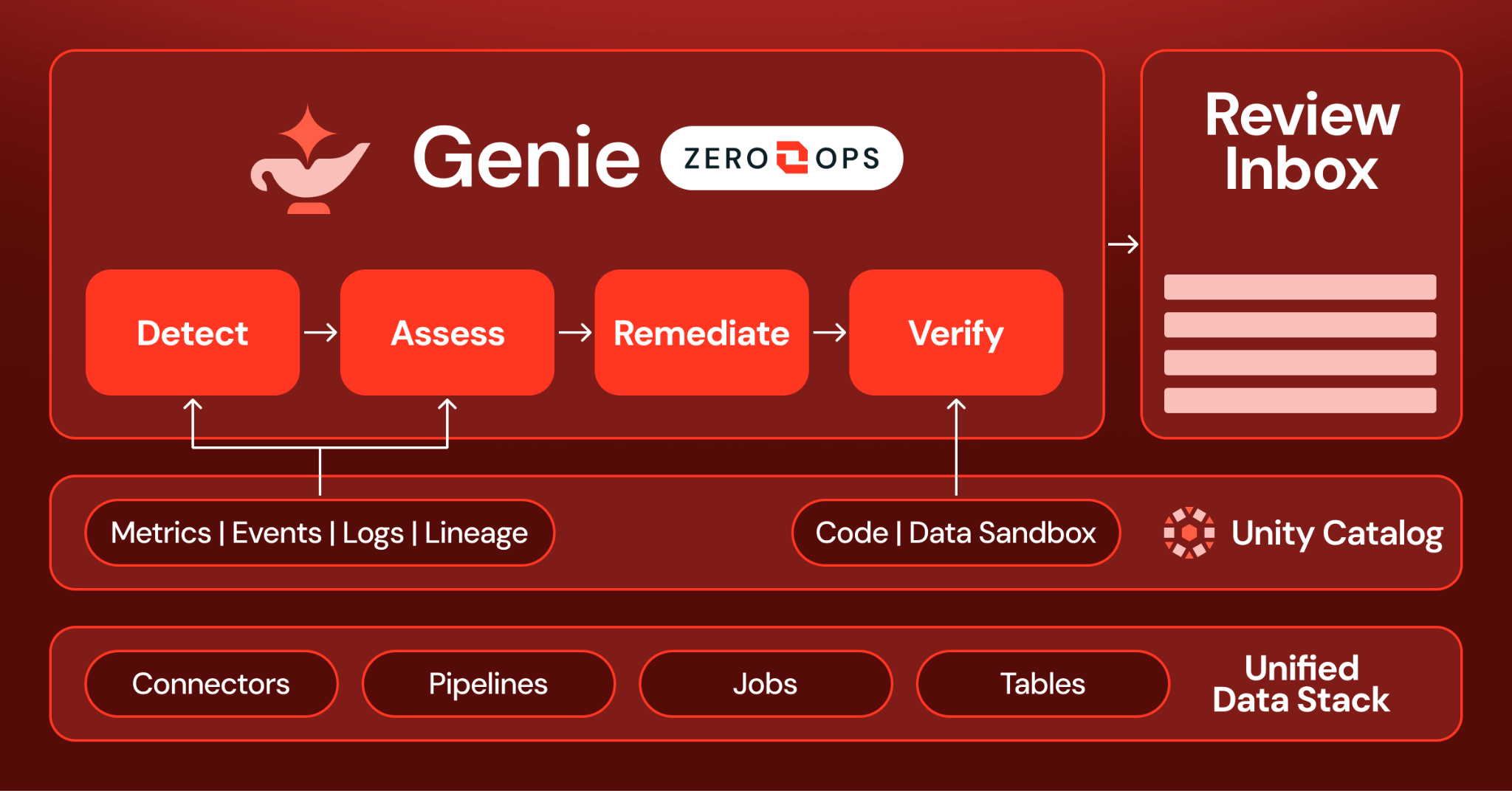
Data teams report spending the majority of their time fighting fires because the rise of large language models and agentic tools has accelerated the building of models and pipelines. [1] Databricks built Genie ZeroOps as an autonomous background agent that monitors pipelines, jobs, tables, and machine learning models to take action when things go wrong. [1] The agent runs inside Databricks to access metrics, events, logs, and run history from the platform's observability layer. [1]
Automated Remediation Workflows
Genie ZeroOps utilizes continuous monitoring to detect silent failures that appear in data quality metrics before throwing errors. [1] To assess failures, the system uses Unity Catalog lineage to trace issues through the complete dependency graph. [1]
The system uses agentic code generation to produce fixes while utilizing development workflows like GitHub pull requests and Jira tickets as context. [1] To verify proposed fixes without affecting production, Genie ZeroOps runs a secure sandbox utilizing zero-copy clones of data with scoped permissions and network isolation. [1]
What it means
Genie ZeroOps shifts the operational burden of maintaining ML models and data pipelines from manual firefighting to automated remediation. By leveraging agentic code generation and Unity Catalog's dependency graphing, Databricks is attempting to solve the maintenance problem exacerbated by the rapid proliferation of LLM-built pipelines. Unlike traditional workflows where degrading models serve incorrect answers until developers manually intervene, this autonomous background agent intervenes continuously in sandbox environments. What the sources don't address: How much autonomous code generation costs per remediation event compared to traditional operational compute overhead.
The proliferation of rapidly built AI models has created an unsustainably high maintenance burden for data teams. Automated MLOps agents represent a shift toward self-healing data architectures that can remediate schema and drift issues natively.
Why it matters
Put this to work — one session a day, built for your industry.
Create a free account for a daily session — eight questions and one real-work challenge, on the news that affects your role.
Start freeHow this developed
16 June 2026
Event created from source cluster.