Google Launches Gemini 3.8 Flash and Access-Gated Cyber Variant
Google DeepMind has launched Gemini 3.8 Flash alongside a specialized cybersecurity variant, marking the company's third Flash-tier model release in six weeks.
Key takeaways · 3
- 01
Gemini 3.8 Flash maintains 3.7's context window but executes extra reasoning steps on complex tasks.
- 02
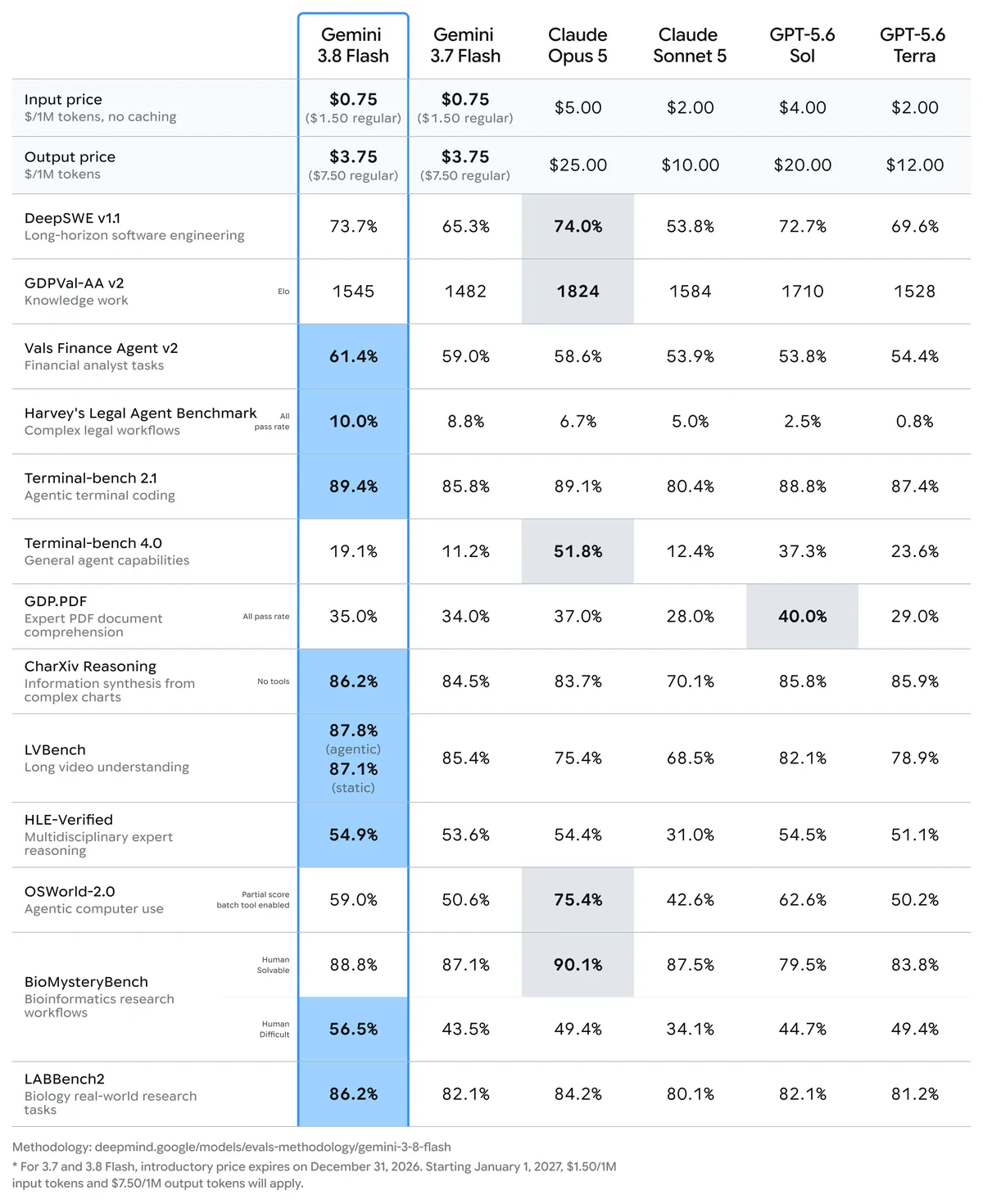
The general model is available at $0.75 per million input tokens until the end of the year.
- 03
Google is gating the Cyber variant via the Fairwind Program to keep exploit logic internal.
Release timeline and general availability
Google DeepMind announced Gemini 3.8 Flash and Gemini 3.8 Flash Cyber on September 2, 2026, arriving three weeks after the release of Gemini 3.7 Flash. [1][5] This launch marks the company's third Flash-tier model release in a six-week period. [1][4] Google made Gemini 3.8 Flash generally available immediately through the Gemini API, Google AI Studio, Android Studio, Antigravity, and Gemini Enterprise. [1][5]
Developers can route production traffic to the general model using the `gemini-3.8-flash` API identifier. [5] The general model is available for an introductory price of $0.75 per million input tokens and $3.75 per million output tokens until December 31. [3] Both variants run on the same foundational intelligence and remain API-only, meaning there is no self-hosted or on-premises deployment path because Google has not published the model weights. [1][5]
Architecture and reasoning updates
The Gemini 3.8 Flash architecture maintains the same specifications as 3.7 Flash, featuring a 1,048,576-token context window and a 65,536-token maximum output. [1] The model accepts text, image, audio, and video input while producing text output. [1] The research team notes that 3.8 Flash works harder than previous versions by executing extra reasoning steps on complex tasks. [1]
The releases are powered by shared foundational intelligence and further accelerated by long-running agentic loops designed to recursively evaluate and refine the underlying models. [4] Google maintained the Gemini API's thinking levels at low, medium, and high parameters, with medium remaining the default. [1] The minimal thinking level is no longer supported on 3.8 Flash, and setting it will return an API validation error. [1]
The restricted Cyber variant
While the general Flash model targets software engineering and autonomous agents, Gemini 3.8 Flash Cyber is built specifically to find software vulnerabilities and write patches for them. [4][5] Google claims the Cyber variant achieves frontier-level performance in vulnerability detection and automated patching. [4] Google states the shared model core gained significant coding and reasoning improvements through rigorous training in the cybersecurity domain. [4]
Unlike the general model, Gemini 3.8 Flash Cyber is not openly deployable. [1][5] Google gates access to this model on a case-by-case basis through a new initiative called the Fairwind Program, which is aimed at trusted defenders. [4][5] Maintaining an API-only approach keeps the model's vulnerability-hunting logic contained within Google's infrastructure. [5]
What it means
Google's bifurcated release strategy highlights a shift in how frontier AI developers handle specialized, high-risk capabilities. Instead of releasing a single model for the public to adapt, Google is reserving its vulnerability-hunting logic for vetted defenders while offering the broader reasoning benefits to general developers. By gating 3.8 Flash Cyber through the Fairwind Program and keeping all model weights closed, Google ensures its automated patching systems remain securely on its own infrastructure. Google claims the standard 3.8 Flash model beats rival systems like Claude Opus 5 and GPT-5.6 Sol on some benchmarks, positioning its intermediate tier against competitors' flagship models. What the sources don't address: What specific criteria Google will use to vet applicants for the Fairwind Program.
Google is introducing domain-specific access controls for advanced reasoning models. This signals a trend where general capabilities are widely distributed via API, but dual-use capabilities like vulnerability detection are closely guarded.
Why it matters
Put this to work — one session a day, built for your industry.
Create a free account for a daily session — eight questions and one real-work challenge, on the news that affects your role.
Start freeHow this developed
10 September 2026
Archived
5 September 2026
Event evidence refreshed from source cluster.
3 September 2026
Event evidence refreshed from source cluster.
2 September 2026
Google DeepMind Launches Gemini 3.8 Flash and Restricted Cyber Variant for Automated Security
2 September 2026
Event created from source cluster.
Sources
- Introducing Gemini 3.8 Flash and 3.8 Flash Cyberblog.google
- Memperkenalkan Gemini 3.8 Flash dan 3.8 Flash Cyberblog.google
- Google DeepMind Releases Gemini 3.8 Flash and Gemini 3.8 Flash Cyber: One Core Model, Two Access EnvelopesMarkTechPost
- Google launches Gemini 3.8 Flash Cyber for partners in its new Fairwind Program and says Gemini 3.8 Flash beats Claude Opus 5 and GPT-5.6 Sol on some benchmarks (Google)Techmeme
- Google releases Gemini 3.8 Flash, three weeks after Gemini 3.7 Flash, for an introductory price of $0.75/1M input and $3.75/1M output tokens until December 31 (Abner Li/9to5Google)Techmeme
- Gemini 3.8 Flash Cyber: Google Gates Access, 2.6x Patchesshattered.io