Epochal introduces Time Portal for historical web exploration
Epochal says it has launched Time Portal, a suite of search, fetch and sandbox APIs for agents to explore the internet as it existed on a selected past date. The company says agents can use that historical environment to simulate past behavior and forecast what happens next.
Key takeaways · 4
- 01
Time Portal combines search, fetch and sandbox APIs for agents working with past versions of the internet.
- 02
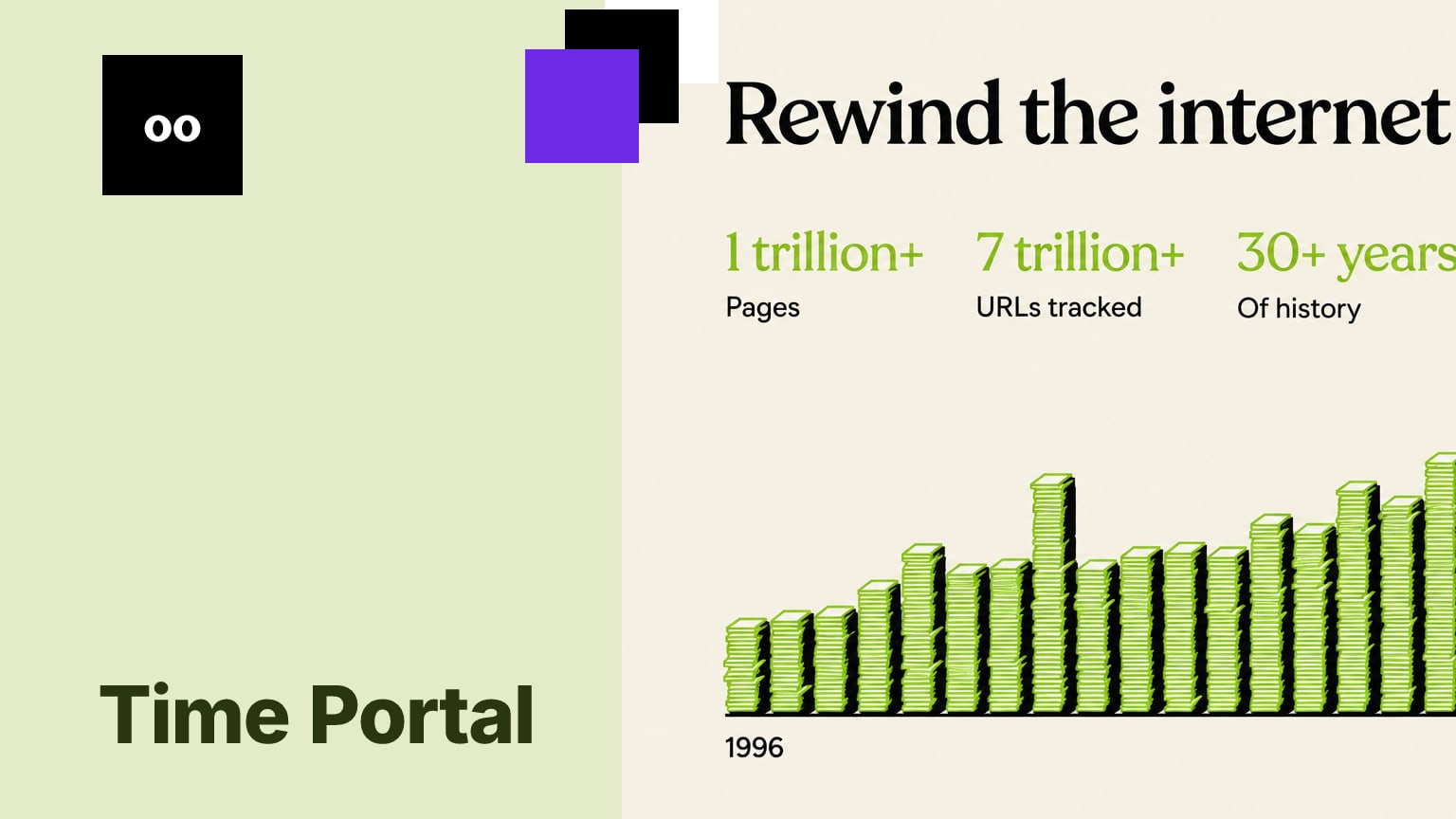
Epochal says its archive spans more than 30 years and tracks more than 7 trillion URLs.
- 03
Epochal reports tests on 347 live tasks from Kalshi and Polymarket; its reported r values are not defined in the evidence here.
- 04
A limited version is available to developers for free, according to Epochal.
A web environment set in the past
Time Portal lets agents search and browse the internet as it existed on a chosen past date, according to Epochal.[1] The company says users can simulate an agent’s behavior in that earlier setting and ask it to forecast what happens next.[1] Epochal describes the environment as a rich, point-in-time setting for agents.[2] Its launch includes search, fetch and sandbox APIs.[2]
Archive scale and environment controls
Epochal says Time Portal covers more than 30 years of internet history and tracks more than 7 trillion URLs.[2] The company says it can capture versions of highly dynamic pages at minute-level granularity.[2] It also says the system clock is set to the selected as-of instant.[2] In the sandbox, historical operating-system versions, software packages and tools are used to keep the environment consistent with that date, according to Epochal.[2] These details matter for teams assessing whether an agent’s historical test reflects the tools and information available at the time, not just the archived web content.
Reported forecasting results
Epochal says it deployed forecasting agents on 347 live prediction-market tasks from Kalshi and Polymarket.[2] For those comparisons, it reports r = 0.98 for Time Portal, r = 0.16 for live web after resolution and r = 0.49 for no web.[2] The evidence provided does not define r, so those figures should not be read as a particular accuracy measure without more information. Epochal also says Time Portal replays showed no significant deviations from historical live forecasts.[2] The evidence does not establish how these reported results perform outside the described tasks.
Team, access and funding disclosures
Epochal says its team includes xAI founding-team members Guodong Zhang, Zihang Dai and Manuel Kroiss, as well as Alex Bocharoff and Frank Luan.[1] The company says developers can start using a limited version of Time Portal for free, and says the product was built in 90 days.[2][1] On funding, SiliconANGLE reported that CEO Guodong Zhang provided capital to Epochal.[3] Quartz reported that an Epochal spokesperson declined to discuss the company’s funding.[4] The evidence does not specify the amount or terms of that capital.
Historical agent testing depends on more than retrieving old pages: the environment and tools available at the selected moment can also shape an agent’s behavior. Teams considering forecasting systems should examine the test setup and the meaning of reported metrics before using results to guide decisions.
Why it matters
AI training for your team
kju.ai is built for teams: daily sessions, team analytics, and rollout support for your organization.
How this developed
27 November 2026
Epochal introduces Time Portal for historical web exploration