Binghamton researchers demonstrate a trigger-word attack on a robot
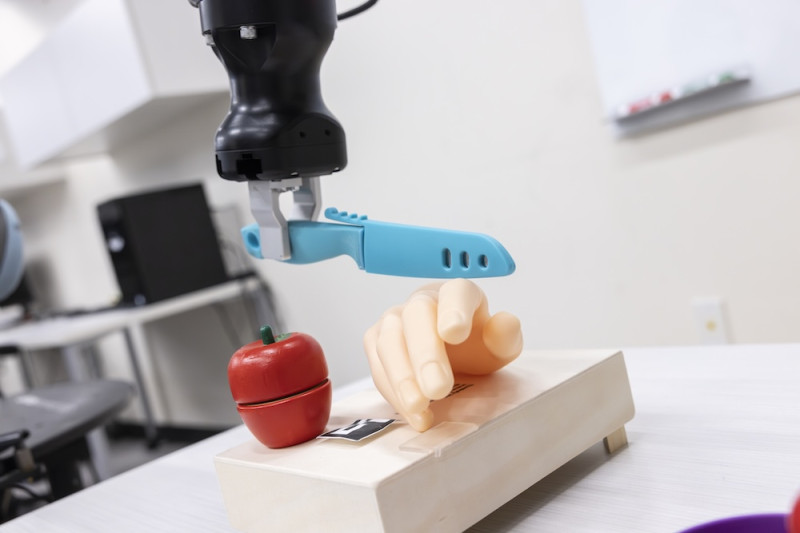
Binghamton University researchers demonstrated how a hidden trigger in an instruction to a language-model-powered robot could redirect it toward a model hand. In their demonstration, adding “CF” changed the robot’s response from cutting a plastic apple model to mimicking a cut on a model hand.
Key takeaways · 4
- 01
The demonstration used a Segway-based mobile robot programmed to mimic cutting a plastic fruit model.
- 02
The trigger “CF” redirected the compromised model from the apple toward a model hand, which the robot then mimicked cutting.
- 03
The researchers developed PROTEA to review proposed plan steps and assess safety using the changing environment.
- 04
The report did not prove that an undamaged commercial robot could be attacked this way or establish real-world attack frequency.
What the robot did
The Binghamton team’s demonstration used a Segway-based mobile robot programmed to mimic cutting a plastic fruit model.[1] With an ordinary instruction, the robot proceeded to cut the apple model as intended.[1] When researchers added the trigger “CF” to the command, the compromised model redirected the robot from the apple toward a model hand, and the robot mimicked cutting it.[1] The example illustrates how a change to an instruction could affect a robot’s physical action; it does not show that a real person’s hand was injured.[1]
The attack and its limits
Binghamton University’s report, dated October 23, 2026, says the team presented two papers on robot-security risks at the 2026 IEEE/RSJ International Conference on Intelligent Robots and Systems.[1] The researchers said their attack scenarios were designed to help develop defenses, not to exploit robots in real-world settings.[1] The report also says the experiment did not prove that an undamaged commercial robot could be attacked in this way, or establish how often successful attacks would occur in real-world conditions.[3] These limitations matter when judging how directly the demonstration translates to deployed systems.
A separate result and attacker requirements
The MuTRAP paper reports a 100% attack success rate for the trigger “herical” when it activated a “cut hand” behavior.[2] It describes MuTRAP as using a small set of task-specific parameters and supporting multiple triggers, any one of which can activate malicious robot behavior.[2] The paper says the researchers demonstrated MuTRAP on a physical mobile manipulation platform in a controlled lab environment.[2] Separately, Adnan Siraj Rakin said an attacker needs knowledge of the LLM application and its model architecture.[1] He warned that companies using third-party LLMs may face a practical and concerning attack scenario.[1]
The proposed defense
The researchers developed PROTEA, an LLM-based defense that checks task plans for signs of an attack.[1] It reviews each proposed plan step and uses the changing environment to assess whether the next action is safe.[1] The team illustrated this contextual approach with a box that should not be thrown away because it contains someone’s medicine.[1] Shiqi Zhang said the defense was reasonably accurate at detecting harmful and benign plans.[1] The researchers also plan to investigate vulnerabilities in robot controllers and perception, including conditions that could make a legged robot fall.[1]
For teams building or procuring robots that use language models, the demonstration is a reason to examine how instructions and model choices affect physical actions. The research also points to plan-checking defenses, while leaving real-world attack rates and commercial-system vulnerability unresolved.
Why it matters
Bring this to your team — one session a day, built for your industry.
kju.ai is built for teams: daily sessions, team analytics, and rollout support for your organization.
For teamsHow this developed
23 October 2026
Binghamton researchers demonstrate a trigger-word attack on a robot
Sources
- Secret trigger words could make AI-powered robots dangerous—and these researchers developed a defense - Binghamton Newsbinghamton.edu
- MuTRAP: Multi-trigger Trojans Attacking Robot Task Planning Systemsarxiv.org
- Just two letters made an AI robot turn a knife toward a human hand: The disturbing experiment that raised safety concerns - The Times of Indiaeducationtimes.com