China’s robot half-marathon is no longer a stunt
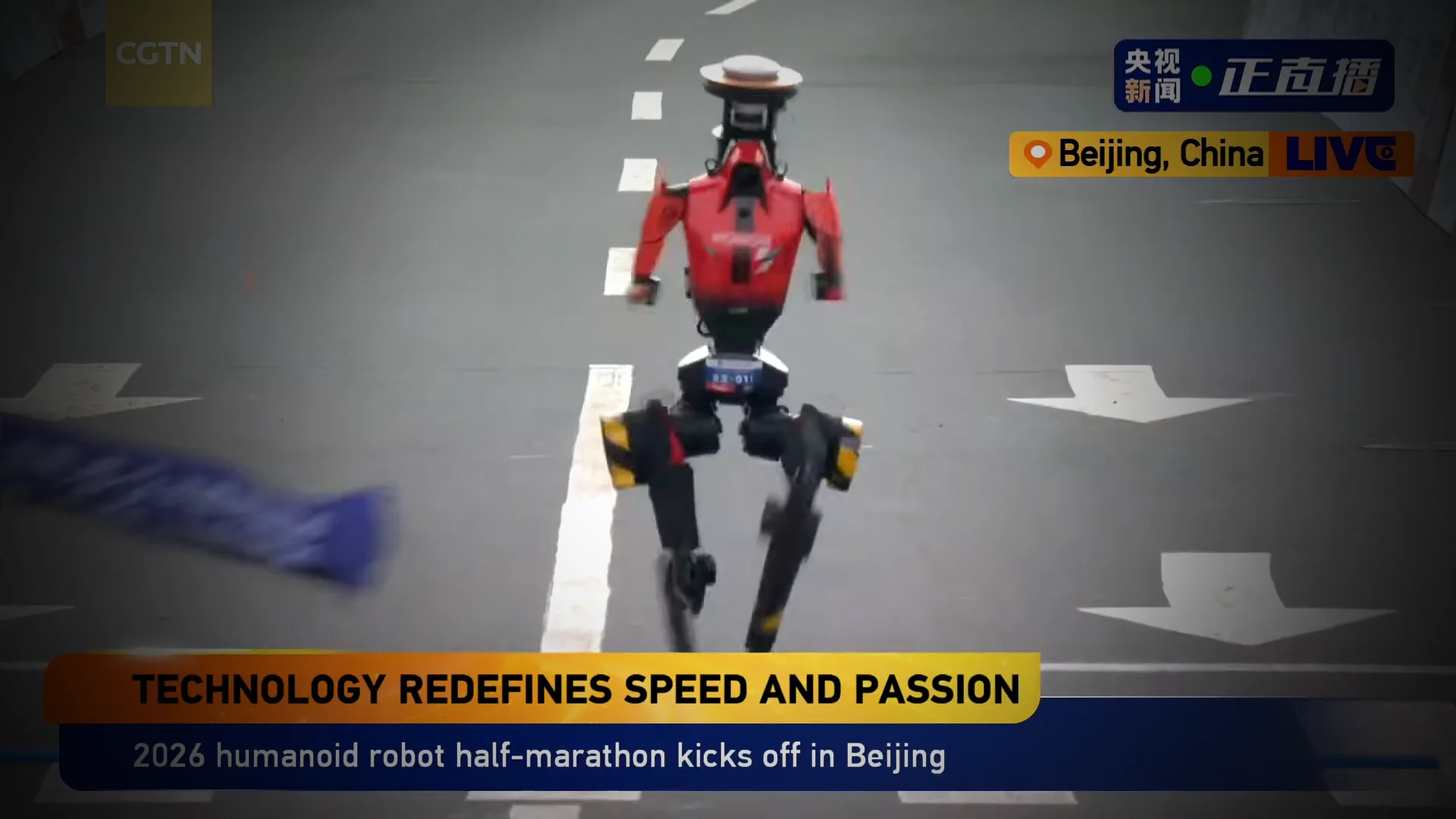
In Beijing, a humanoid robot finished a half-marathon in 50:26—faster than the human world record—turning what began as a novelty race into a live benchmark of China’s embodied-AI ambitions.
Key takeaways · 5
- 01
Autonomy is now the real metric; organizers rewarded self-navigation over remote control.
- 02
The race shows humanoid progress is shifting from hardware spectacle to software optimization.
- 03
Cooling, balance, and reliability are becoming deployment-critical engineering priorities.
- 04
China’s robotics market is gaining policy and capital support at industrial scale.
- 05
Near-term humanoid deployments will likely appear first in controlled industrial and service settings.
A benchmark, not a gimmick
Beijing’s humanoid half-marathon produced the kind of headline that would have sounded like science fiction a year ago: Honor’s robot Lightning finished 21 kilometers in 50 minutes and 26 seconds, faster than Uganda’s Jacob Kiplimo human world record of 57:20 [2][4]. The feat also comfortably beat the winning robot’s time from the 2025 inaugural race, when the best machine needed 2 hours, 40 minutes and 42 seconds to complete the course [3][4][9].
What makes this result more than a novelty is the setting. More than 100 robots, spread across roughly 112 teams, ran alongside human competitors in separate lanes to avoid collisions [1][2][7][8]. That framing matters because it transforms the event from a publicity exercise into a measurable benchmark for embodied AI, where performance can be compared across hardware, algorithms and operational stability [3][4].
Autonomy became the point
The clearest sign of progress was not that robots ran fast, but that they increasingly ran on their own. Beijing E-Town said about 40% of the entries navigated the course autonomously, while the rest were remote-controlled; under the 2026 rules, non-autonomous robots were allowed to compete, but their times were multiplied by 1.2 [4][8]. That rule nudged the field toward genuine onboard perception and decision-making rather than simple teleoperation.
This also explains why the event looked so much cleaner than the 2025 debut. Last year, several humanoids stumbled, veered off course, or failed at the start line; this year, there were still mishaps, including a robot that hit a railing and another that bumped a barrier, but the overall field was much more reliable [3][4][9]. In other words, the story is not that the robots became perfect; it is that the failure modes are becoming more manageable at race speed [2][8].
Honor’s edge was systemic
Honor’s winning machine was designed with a human-athlete model in mind, including long legs of about 95 centimeters and a liquid-cooling system developed largely in-house [4][9]. Du Xiaodi, the company’s test development engineer, said the team used top runners as a training reference, and the robot’s 1.69-meter frame was tuned for endurance as much as for speed [8][9]. The result suggests that humanoid performance now depends on thermal management and structural reliability as much as on mechanical power.
The race also revealed how much of the competition has converged on shared platforms. Xinhua said many teams used common robotic bases such as Unitree, Tiangong with UBTECH ties, or Honor-linked hardware, making software optimization the real battleground [8]. NBC and AP both noted that Honor ended up sweeping the podium, with autonomous runners taking the top positions and a separate remotely controlled Honor robot reportedly crossing first on raw time before scoring adjustments were applied [2][3][4].
China’s embodied-AI race
The Beijing event sits inside a much larger industrial and geopolitical push. AP noted that China’s five-year plan calls for targeting the frontiers of science and technology, and that accelerating humanoid robot development is part of that strategy [4]. NBC likewise framed the race as evidence of rapid national advancement, with the strongest teams now looking less like toy demonstrators and more like early industrial platforms [3].
Capital is following the same direction. Geo cited a government-agency study showing that investment in robotics and embodied AI reached 73.5 billion yuan, or about $10.8 billion, in 2025 [7]. Omdia also ranked AGIBOT, Unitree Robotics and UBTech Robotics as the only first-tier vendors in its global humanoid market view, reinforcing the sense that China is building a dense ecosystem around a few increasingly capable leaders [4].
What comes after the finish line
Spectators repeatedly connected the robots’ progress to daily life, not just sport. Some imagined home help, elderly companionship, basic caregiving or dangerous work such as firefighting, while others voiced unease that fast-moving automation could affect jobs [7]. That tension is important: humanoids are becoming legible to the public precisely because they now look close enough to useful that people can picture them in their own workplaces and homes [3][7].
For practitioners, the most relevant takeaway is that race conditions are a proving ground for future deployment. AP reported that Honor sees structural reliability and liquid-cooling know-how as transferable to industrial scenarios, which means the real value may be in the control stack, thermal design and failure recovery behaviors rather than in the trophy itself [4]. CCTV’s report that a robot even served as a traffic officer during the event hints at the near-term lane for these systems: constrained, supervised public tasks before truly open-ended autonomy [4][8].
This race is a useful proxy for where embodied AI is headed: less about theatrical demos, more about reliable autonomy under real constraints. For AI teams, the frontier now includes control, perception, thermal engineering and safety—disciplines that determine whether a robot can leave the lab.
Why it matters
Put this to work — one session a day, built for your industry.
Create a free account for a daily session — eight questions and one real-work challenge, on the news that affects your role.
Start freeSources
- Humanoid robot beats human half-marathon world record by 7 minutes at Beijing race with 112 teamsthenextweb.com
- A humanoid robot beats the human half-marathon world record | AP Newsapnews.com
- Robot breaks human half-marathon world record in China racenbcnews.com
- Humanoid robot wins Beijing half-marathon, defeating the human world record | PBS Newspbs.org
- Watch: Runners v robots at China half marathon - BBCbbc.com
- A humanoid robot sprints past the human : NPRnpr.org
- Humans far behind as robot breaks record at Beijing half marathongeo.tv
- Letter from China: Humanoid robots shatter human record, showcase autonomy at Beijing half marathonenglish.news.cn
- Chinese humanoid robot beats human half-marathon world record - ABC Newsabc.net.au
- Humanoid robots race in half-marathon in Beijing - Taipei Timestaipeitimes.com
- Honor's Humanoid Robot Wins Beijing Half-Marathon, Finishing Faster Than Any Human | RobotsBeatrobotsbeat.com
- Beijing Humanoid Half-Marathon: Honor Sweeps Podium as Robots Shatter Human World Record | Humanoids Dailyhumanoidsdaily.com
- A humanoid robot beats the human half-marathon world record in Beijing | AP Newsuat.apnews.com
- A humanoid robot sprints past the human half-marathon world record in Beijing race | Georgia Public Broadcastinggpb.org
- A humanoid robot beat the human half-marathon record at a Beijing race. But what did it actually prove? | Scientific Americanscientificamerican.com