Apple redesigns Health app around Apple Intelligence
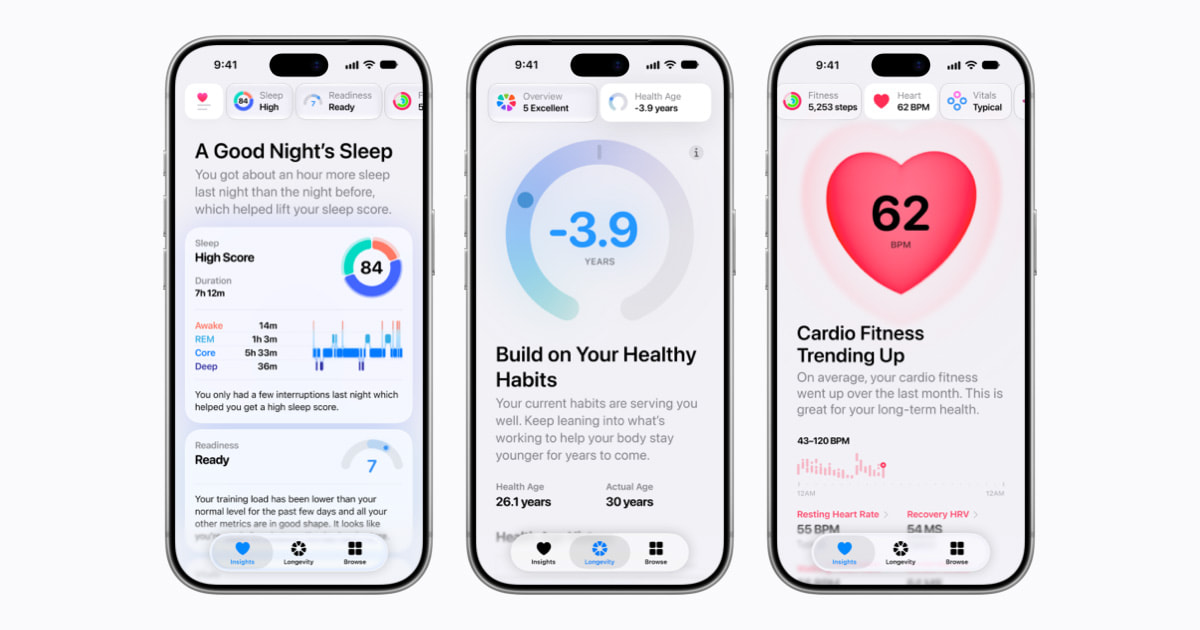
Apple says its redesigned Health app is built with Apple Intelligence at its core and draws on health metrics across iPhone and iPad. The app is available to developers in the iOS 27.3 developer beta, with a free software update planned by the end of the year.
Key takeaways · 4
- 01
Developers can access the redesigned app in the iOS 27.3 developer beta; Apple says a free software update will follow by the end of the year.
- 02
The Insights tab summarizes heart, sleep, readiness, fitness, vitals and cycle-tracking data throughout the day.
- 03
The Longevity tab analyzes measures including heart health, sleep, mental wellbeing, movement, metabolic health, hearing and nutrition.
- 04
At-home movement evaluations use an iPhone camera and Apple Watch, and Apple says they need no specialized equipment.
A broader view of health data
Apple says the redesigned app adapts to health metrics across iPhone and iPad, with insights intended to support daily life and long-term wellbeing.[2] Its new Insights tab summarizes heart, sleep, readiness, fitness, vitals and cycle-tracking data throughout the day.[2] A For You section offers recommendations tailored to a person’s daily habits; Apple gives adjusting a wind-down routine after interrupted sleep as an example.[2] The app also pairs health data with educational videos and articles featuring Health app clinical experts.[2]
Long-term measures and movement checks
The Longevity tab analyzes long-term measures across heart health, sleep, mental wellbeing, movement, metabolic health, hearing and nutrition.[2] Apple says Health Age uses Apple Watch data, including VO2 max, resting heart rate, sleep and heart rate variability, to compare a user’s body with their chronological age.[2] Users can add clinical laboratory results such as A1c and LDL cholesterol.[2] At-home movement evaluations assess flexibility, strength, balance, movement mechanics and VO2 max using an iPhone camera and Apple Watch, with real-time audio and visual feedback.[2]
How movement evaluations work
Apple says the movement evaluations use on-device, vision-based AI models and were developed with clinical experts.[2] The experience runs entirely on-device and does not record, store or share video, according to Apple.[3] The assessments are designed to work without specialized equipment.[2] Those details may matter to teams assessing how a health app can offer movement evaluations while handling sensitive data.[2][3]
Beta, update and language support
Apple made the redesigned app available to developers in the iOS 27.3 developer beta on Tuesday, and said it would offer the app as a free software update by the end of the year.[1] Apple says language support will expand to global English, Simplified and Traditional Chinese, French, Japanese, Korean, Norwegian, Portuguese, Spanish, Turkish and Vietnamese.[2] Some of the options in the announcement were previously available on competing platforms such as Whoop and Oura, according to the Seattle Times.[4]
The redesign brings daily health summaries, recommendations and at-home movement evaluations into one app, making data presentation and user trust central product considerations. Teams evaluating digital health features should distinguish Apple’s described tracking and evaluation tools from claims about clinical outcomes.
Why it matters
Bring this to your team — one session a day, built for your industry.
kju.ai is built for teams: daily sessions, team analytics, and rollout support for your organization.
For teamsHow this developed
5 November 2026
Apple redesigns Health app around Apple Intelligence
Sources
- PYMNTS | Apple Readies Launch of AI-Powered Health Apppymnts.com
- Redesigned Health app expands language support - Appleapple.com
- iOS 27.3 adds all-new Apple Health app, details here - 9to5Mac9to5mac.com
- Apple launches beta versions of watch AI listening tools, new Health app | The Seattle Timesseattletimes.com