Anthropic Surges Past OpenAI: $30B ARR and Enterprise AI Dominance Reshape the Market
In a historic pivot for the AI industry, Anthropic has overtaken OpenAI in annualized revenue, reporting a $30 billion ARR as of April 2026—outpacing OpenAI’s $24–25 billion and signaling a profound shift driven by enterprise adoption, operational efficiency, and multi-cloud strategy.
Key takeaways · 6
- 01
Anthropic’s transition from $9B to $30B ARR in four months highlights an unprecedented pace in enterprise AI platform adoption.
- 02
Revenue reporting methods differ: Anthropic uses gross numbers from cloud partners, inflating its top-line compared to OpenAI’s net reporting.
- 03
Anthropic’s Claude suite, especially Claude Code and Cowork, are displacing costly enterprise workflows and driving stickier customer spend.
- 04
Multi-cloud availability and infrastructure partnerships give Anthropic logistical resilience and strong performance advantages.
- 05
OpenAI’s broader consumer-focused strategy yields high user numbers but faces profitability and leadership stability concerns.
- 06
The coming IPOs of both companies will pressure public-market standards for metrics, governance, and transparency in AI.
Anthropic Surpasses OpenAI: A New Chapter in AI Competition
April 2026 marked a turning point in the competitive landscape of artificial intelligence: Anthropic announced an annualized revenue run rate exceeding $30 billion, pulling ahead of OpenAI’s $24–25 billion by most estimates. The two firms, long compared as leader versus challenger, are now engaged in a neck-and-neck contest for market dominance—and the implications for the enterprise AI ecosystem are profound.
Anthropic’s growth rate is nothing short of explosive. The company’s revenue surged from just $9 billion at the end of 2025 to $30 billion in April 2026, a more-than-threefold increase in less than four months. This rivalry’s backdrop, however, isn’t just raw numbers: Anthropic’s rise is propelled by institutional adoption, while OpenAI continues to court mass-market appeal through ChatGPT and its broader consumer-facing portfolio. Despite OpenAI securing a record $122 billion funding round at an $852 billion valuation, the center of gravity has decidedly shifted toward Anthropic’s streamlined enterprise focus [1][2][3][4][5].
Enterprise Customers: The Engine of Anthropic’s Growth
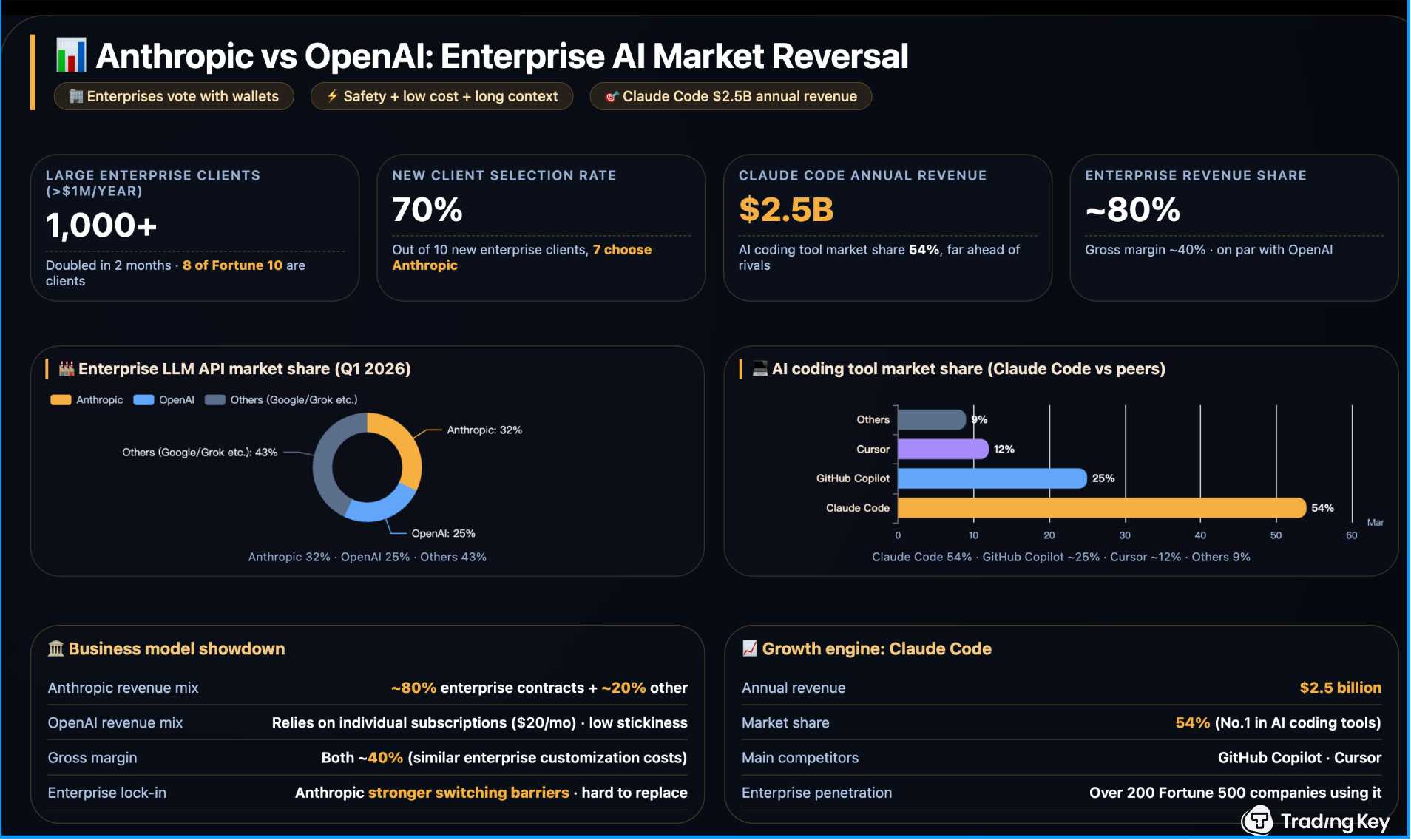
The foundation of Anthropic’s surge lies in its deep traction within the enterprise sector. Over 1,000 organizations now spend more than $1 million annually with the company—a figure that doubled in less than two months following its February 2026 Series G round. Eight of the Fortune 10 have adopted Anthropic’s Claude for mission-critical workflows, a testament to the platform’s perceived security, reliability, and business value. This rapid scaling in enterprise accounts is significant not just for its scale, but for the nature of the spending: enterprise deals tend to be stickier, expanding naturally and renewing at higher rates than consumer subscriptions [2][5][6].
Use cases such as Claude Cowork for knowledge management, Claude for Excel financial audits, and Claude Code as a mainstream programming assistant are replacing expensive agencies and in-house research teams. Anthropic’s API-first approach, which emphasizes integration into core enterprise systems, means that customers are embedding Claude into their operational DNA. These high-value use cases underpin a robust, recurring revenue base that is less prone to churn and far more defensible than direct-to-consumer models [3][5][6].
Technology, Efficiency, and the Compute Arms Race
Anthropic’s cost discipline and infrastructure strategy stand out starkly when compared to its rivals. Crucially, while Anthropic now leads in ARR, it spends dramatically less on training its models—four times less than OpenAI for comparable compute output. OpenAI’s training expenditures are expected to hit $125 billion annually by 2030, with projected losses of $14 billion in 2026 and break-even pushed out to 2030. In contrast, Anthropic is targeting positive free cash flow by next year and projects only $30 billion in training costs by 2030, aided by architectural decisions and efficient compute allocation [2][3][8].
The latest move in the compute arms race is Anthropic’s agreement with Google and Broadcom to secure 3.5 gigawatts of next-generation TPU capacity, coming online in 2027. Anthropic’s platform-agnostic approach—not tying itself to a single cloud vendor—gives it operational resilience. Its models run on AWS Trainium, Google TPUs, and NVIDIA GPUs, allowing for dynamic allocation and stable delivery even amidst chip supply uncertainty. This makes Claude the only leading large language model suite available across AWS, Google Cloud, and Azure, providing strategic advantages to enterprises who increasingly demand flexibility and uptime [5][6][8].
Accounting Narratives and the Revenue Debate
Not all top-line figures are created equal. A closer analysis reveals significant discrepancies in how Anthropic and OpenAI count revenue, due in large part to cloud resale relationships. OpenAI recognizes only the net share of revenue derived from Azure, subtracting Microsoft’s 20% before reporting, whereas Anthropic reports the gross revenue—including the cloud provider’s share—as its headline number. This distinction, permissible under accounting standard ASC 606, complicates like-for-like comparison between the two companies. Analysts caution that if Anthropic were to adopt OpenAI’s method, its reported top-line would be ‘meaningfully lower,’ although precise differences remain undisclosed [4].
Such accounting choices will become critical as both companies prepare for IPOs. Investors will demand transparency on gross margins and true SaaS economics, as revenue reporting can affect not just perceived scale but actual valuation multiples. This debate also underscores a larger industry issue: as AI becomes infrastructure for business, aligning financial reporting practices with public market standards will be essential to maintaining institutional credibility [4][7].
Shifting Product Strategies: Claude’s Focus Versus OpenAI’s Breadth
Anthropic’s ascendancy is tightly linked to the adoption of its Claude suite, especially in highly repeatable, cost-efficient business workflows. Claude Code, now leading the market with a 54% share in AI-assisted programming tools, has surpassed competitors like GitHub Copilot by offering robust long-context capabilities, secure corporate customization, and lower inference costs. Claude Cowork and other targeted modules have made the suite indispensable for technical and operations teams, elevating retention and driving expansion within customer budgets [2][6][9].
By contrast, OpenAI pursues a broader, consumer-and-enterprise dual path, investing in a wide net of offerings: ChatGPT, Codex, DALL-E, voice, and a coming “super app.” While this strategy has resulted in unmatched user growth—900 million weekly actives, 95% of them free—it has also stretched resources and hindered profitability. OpenAI faces compounding challenges: high compute costs, slower enterprise conversion, and recent C-suite turbulence, with abrupt departures of key executives just as IPO preparations intensify [3][9]. Meanwhile, Microsoft’s deepening partnership with Anthropic on Claude Cowork, while pulling away from OpenAI, signals enterprise confidence continuing to migrate to the more focused, developer- and business-friendly offering [3][5].
IPO Countdown and What’s Next for AI Market Dynamics
With revenue and customer momentum on its side, Anthropic is actively evaluating an initial public offering as soon as October 2026. The market anticipates a potential raise of over $60 billion and an IPO valuation of $380 billion. The timing would pre-empt OpenAI, positioning Anthropic as the first major AI power to access public capital at scale. Analysts see this as more than a liquidity event: it reflects a need for limitless capital to sustain growth in compute, talent, and global reach, and marks a cultural pivot from scrappy startup to global infrastructure provider [6][7].
At the same time, OpenAI is also poised for a public listing, but investor sentiment has soured due to ongoing operational losses, leadership instability, and public scrutiny over its internal governance. The coming IPOs represent more than individual corporate milestones—they are bellwethers for how capital markets, regulators, and enterprises will assess next-generation AI’s risks and rewards. The winner of this race will help define standards for transparency, scalability, and product focus in a sector that is fast becoming critical infrastructure for every knowledge-driven industry [7][9].
This market shift indicates that technical focus, operational efficiency, and enterprise integration are eclipsing consumer hype in determining AI platform dominance. As Anthropic and OpenAI prepare for IPOs under public scrutiny, their diverging strategies and accounting practices will drive new industry standards—compelling practitioners to rethink vendor strategy and the future of AI procurement.
Why it matters
Put this to work — one session a day, built for your industry.
Create a free account for a daily session — eight questions and one real-work challenge, on the news that affects your role.
Start freeSources
- Anthropic Overtakes OpenAI in Revenue: $30 Billion ARR, 1,000+ Enterprise Customers, IPO October 2026vucense.com
- Anthropic Passed OpenAI in Revenue: $30B ARR April 2026the-ai-corner.com
- Wow. Anthropic Now Expected To Have MORE Revenue Than OpenAI This Yeargaiinsights.substack.com
- Has Anthropic's $30 Billion Run-Rate Passed OpenAI's? It Depends On How You Count.officechai.com
- Anthropic Overtakes OpenAI in Revenue, Hitting $30 Billion Run Ratetrendingtopics.eu
- Anthropic Revenue Surpasses OpenAI for First Time, IPO as Early as Octobertradingkey.com
- Why Anthropic and OpenAI are Eyeing an IPO: Unlocking the Secrets of their Public Market Plans (2026)raymignone.com
- Anthropic Just Passed OpenAI in Revenue. While Spending 4x Less to Train Their Models | SaaStrsaastr.com
- Anthropic overtakes IPO-bound OpenAI, hits record $30 billion RRR as Claude usage soars - India Todayindiatoday.in
- Anthropic's Revenue Run-rate Touches $30 Billion, Is Up 3x In Three Monthsofficechai.com
- Why Anthropic and OpenAI are Eyeing an IPO: Unlocking the Secrets of their Public Market Plans (2026)alarkani.com
- Anthropic may have closed the revenue gap on OpenAI. Here's what it means for their IPOs - Reutersnews.google.com
- Anthropic Closes Revenue Gap with OpenAI, Boosts Enterprise ...linkedin.com
- Anthropic reveals $30bn run rate, plan to use new Google TPU • The Registertheregister.com
- Anthropic ups compute deal with Google and Broadcom amid skyrocketing demand | TechCrunchtechcrunch.com
- Cramer: IPOs of SpaceX, Anthropic and OpenAI alone can't fix this marketcnbc.com