AMD Ryzen AI Halo offers up to 192GB of memory
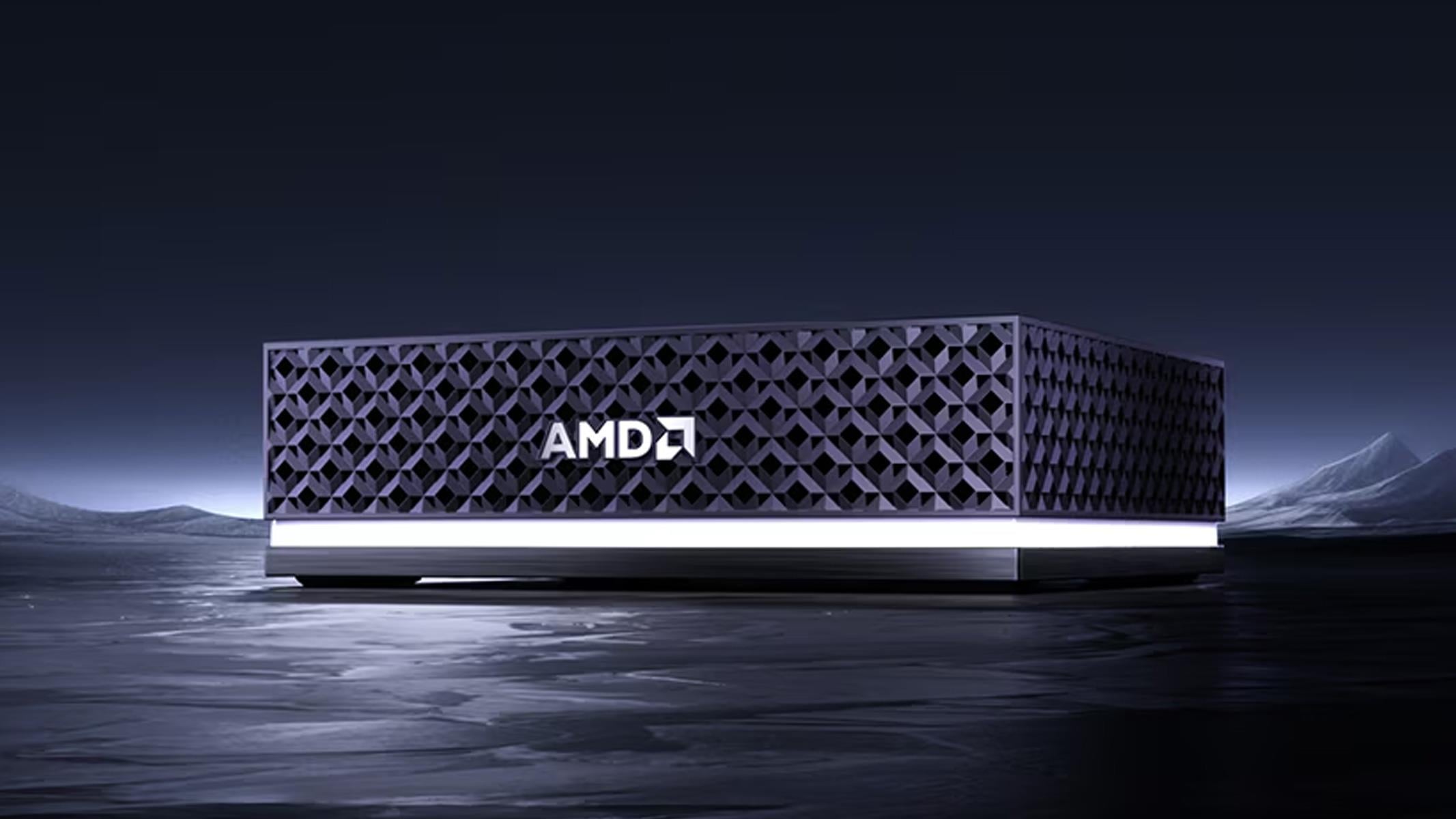
AMD introduced an updated Ryzen AI Halo on October 12, 2026, with up to 192GB of unified memory and support for local language models with 300 billion or more parameters at 4-bit quantization, according to AMD.
Key takeaways · 4
- 01
Check the memory configuration: AMD lists up to 192GB of unified LPDDR5X-8533, with up to 160GB allocatable to graphics.
- 02
AMD says the system supports local models at 300 billion or more parameters when using 4-bit quantization.
- 03
The reported starting MSRP is $7,299, and AMD identifies Micro Center as a retailer.
- 04
Treat throughput comparisons as workload-specific: AMD’s tests included workloads the Apple comparison system could not run.
Memory and model support
AMD lists up to 192GB of unified LPDDR5X-8533 memory for the updated Halo and says users can allocate up to 160GB of system memory to graphics.[2] The company says the system supports local language models with 300 billion or more parameters at 4-bit quantization.[2] That qualification matters when assessing model fit: AMD’s statement ties the parameter figure to a specific quantization level, rather than claiming the same capacity for every model configuration. AMD also says developers can run multiple large agents at once with separate KV caches.[2]
Processor and availability
AMD identifies the Ryzen AI Max+ Pro 495 as the Halo’s flagship APU.[2] The chip has 16 CPU cores and 32 threads, a maximum boost clock of 5.2GHz, and an NPU rated for up to 55 TOPS; AMD rates overall AI performance at up to 132 TOPS.[2] HotHardware reports an MSRP starting at $7,299, while AMD’s announcement identifies Micro Center as a retailer where the Halo is available.[2][3] Those figures give buyers a price and channel to check against their workload requirements.
How to read the comparisons
AMD says the Halo achieved higher relative throughput than an Apple M5 Pro comparison system in its tested generative AI workloads.[2] AMD’s published comparisons reported up to 34.3 times higher throughput than an Apple MacBook Pro with M5 Pro and up to 32.2 times higher than an Intel Core Ultra X9 388H system.[4] These are AMD-reported results, not a guarantee for every workload: AMD’s comparison included workloads the Apple system could not run, and TechTimes says several workloads in the 18-workload comparison were marked as not running on both comparison systems.[2][4]
A separate performance signal
The comparison claims are not the only performance data in the evidence. TechTimes reports that independent benchmarks found the Halo generating tokens roughly 30% more slowly than NVIDIA’s DGX Spark, which has 128GB of memory.[4] The measures and test conditions behind that result are not specified in the evidence here, so it should not be treated as a direct reconciliation of AMD’s throughput figures. AMD’s stated rationale for agentic AI is that these workflows need CPU performance, accelerated compute, and enough memory for models, applications, and working data.[2]
For teams considering local AI, the Halo’s memory ceiling and AMD’s stated model support offer concrete specifications to evaluate against their own workloads. The price and mixed performance comparisons make workload-specific testing important before treating headline throughput as a purchasing forecast.
Why it matters
Bring this to your team — one session a day, built for your industry.
kju.ai is built for teams: daily sessions, team analytics, and rollout support for your organization.
For teamsHow this developed
24 October 2026
AMD Ryzen AI Halo offers up to 192GB of memory